
Agent--Kingbase
1.1 Create Kingbase Instance (Standalone)
Prerequisites
- Created a user.
- Created a storage repository.
- Created a service plan.
- Have access to an installed Kingbase service.
Steps
Step 1: Click Backup Service - Database from the system menu and select the server name to enter the database instance page.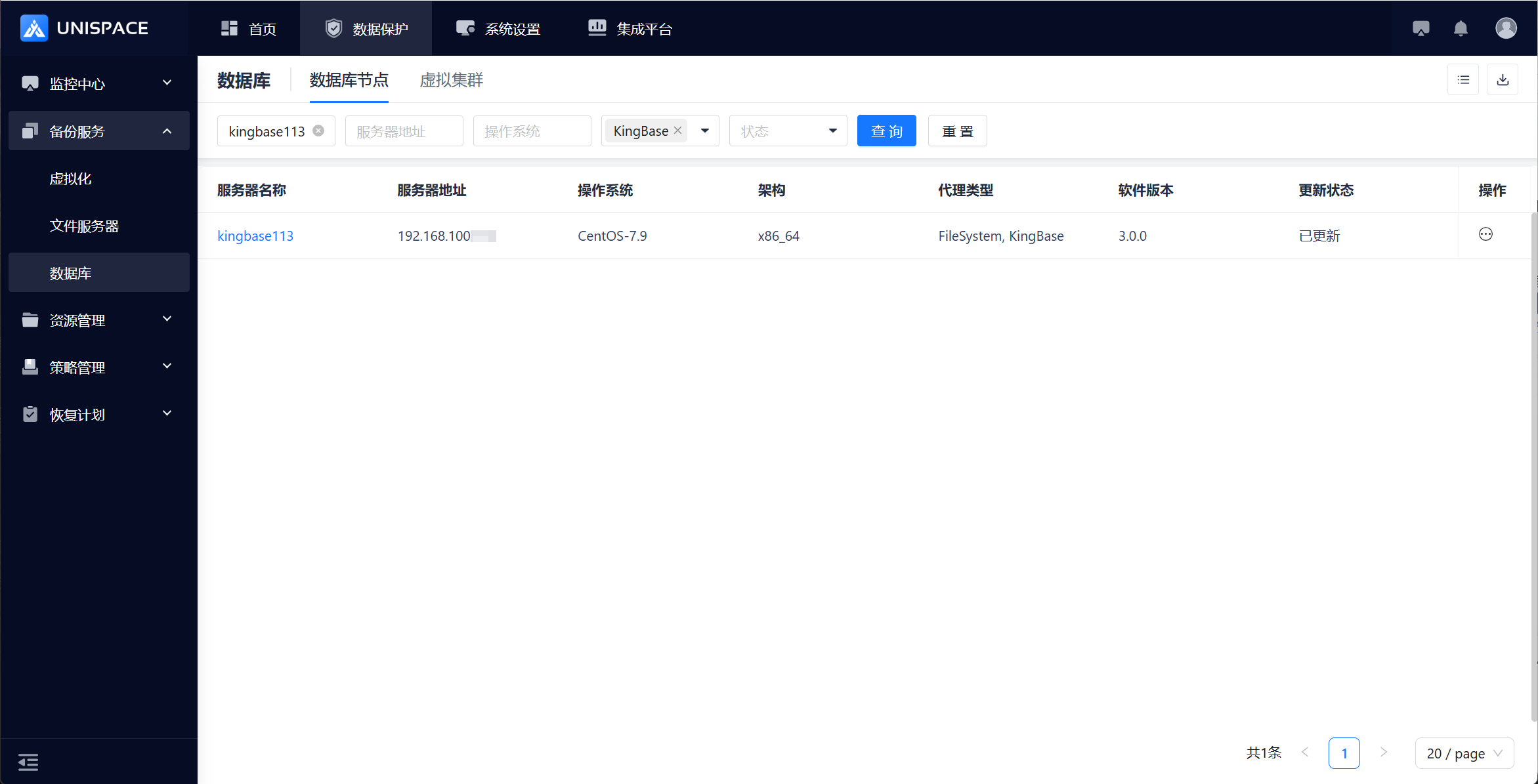 Step 2: Click Instance.
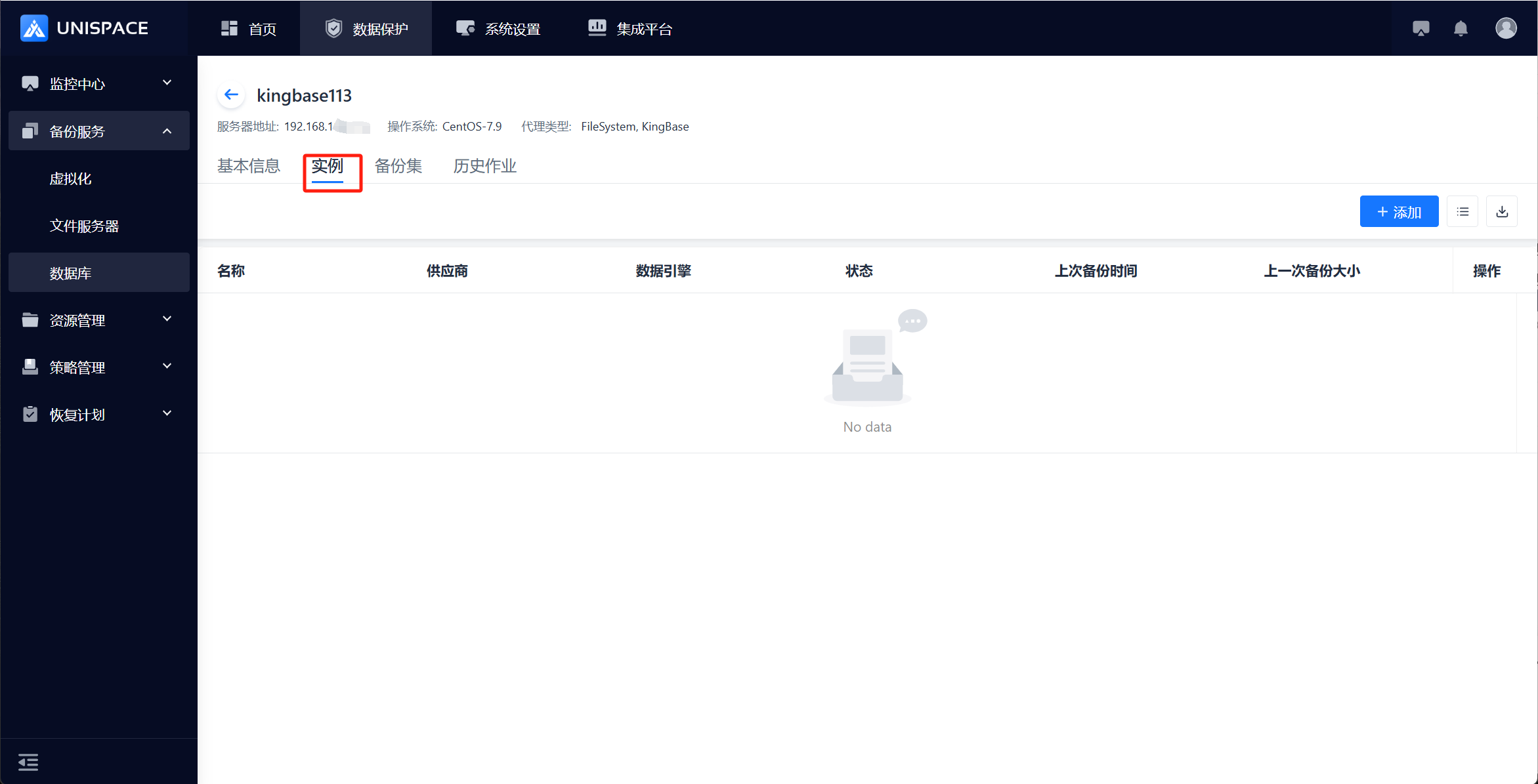 Step 3: Click the Add button on the top right of Add Instance to open the dialog box.
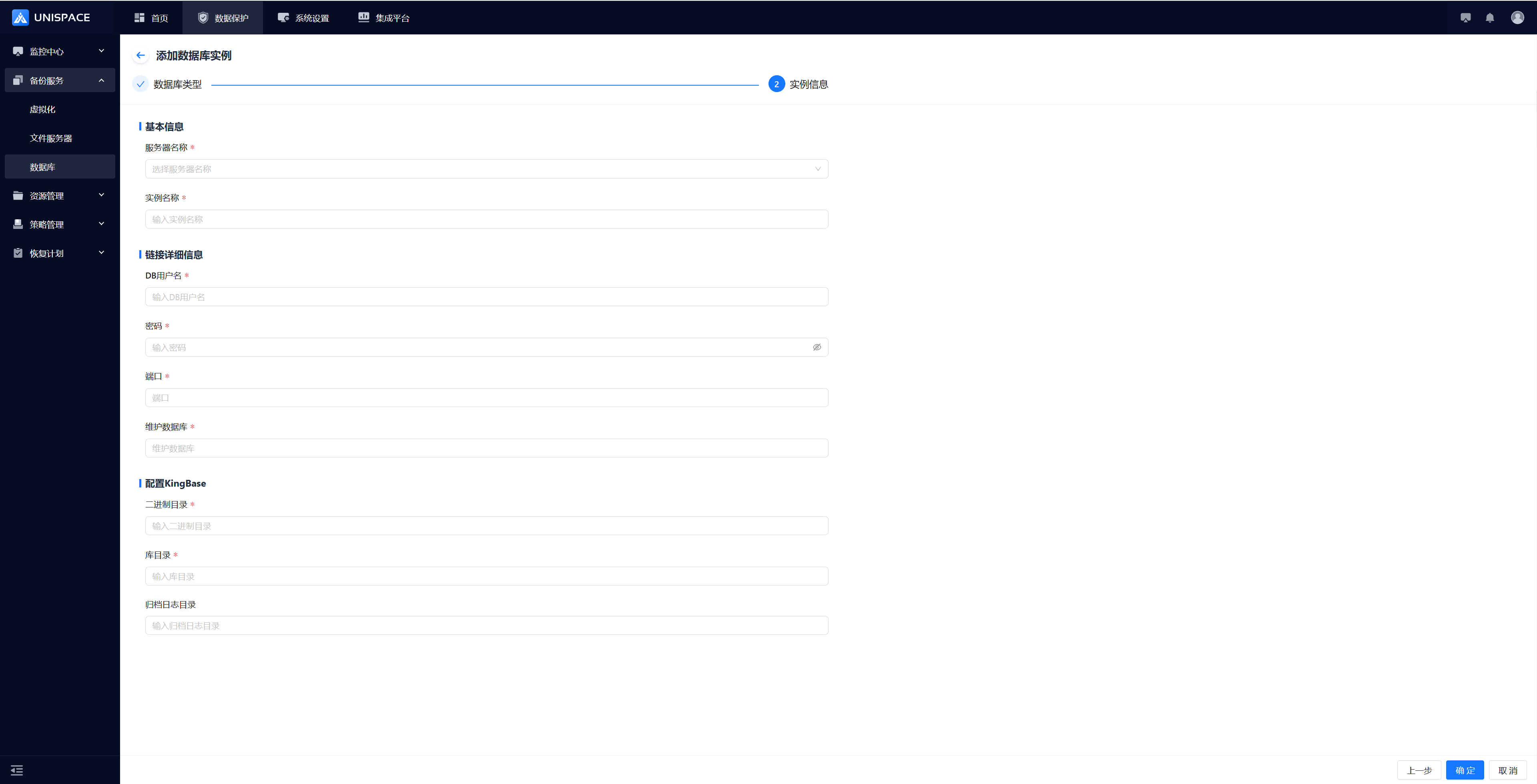 Step 4: Fill in the necessary parameters as follows:
| Parameter Name | Description | Configuration Principle |
|---|---|---|
| Server Name | Dropdown, required | Select the server where the Kingbase instance is located |
| Instance Name | Text input box, required, customizable | No length or special character restriction |
| DB Username | Text input box, required | Enter the Kingbase username |
| Password | Password input box | Enter the Kingbase password |
| Port | Numeric input box, required | Port number, default is 54321 |
| Maintenance DB | Text input box, required | Default value is kingbase |
| Binary Directory | Text input box, required | Enter the correct Kingbase binary directory |
| Database Directory | Text input box, required | Enter the correct Kingbase database directory |
| Archive Log Path | Text input box, path format | Customizable |
Step 5: Click OK to complete the process. The frontend will display a success message indicating that the instance has been added.
1.2 Create Kingbase Backup Object Collection
Prerequisites
- Created a Kingbase instance.
Steps
Step 1: Click Backup Service - Database - Server Name from the system menu to view the list data - Backup Set.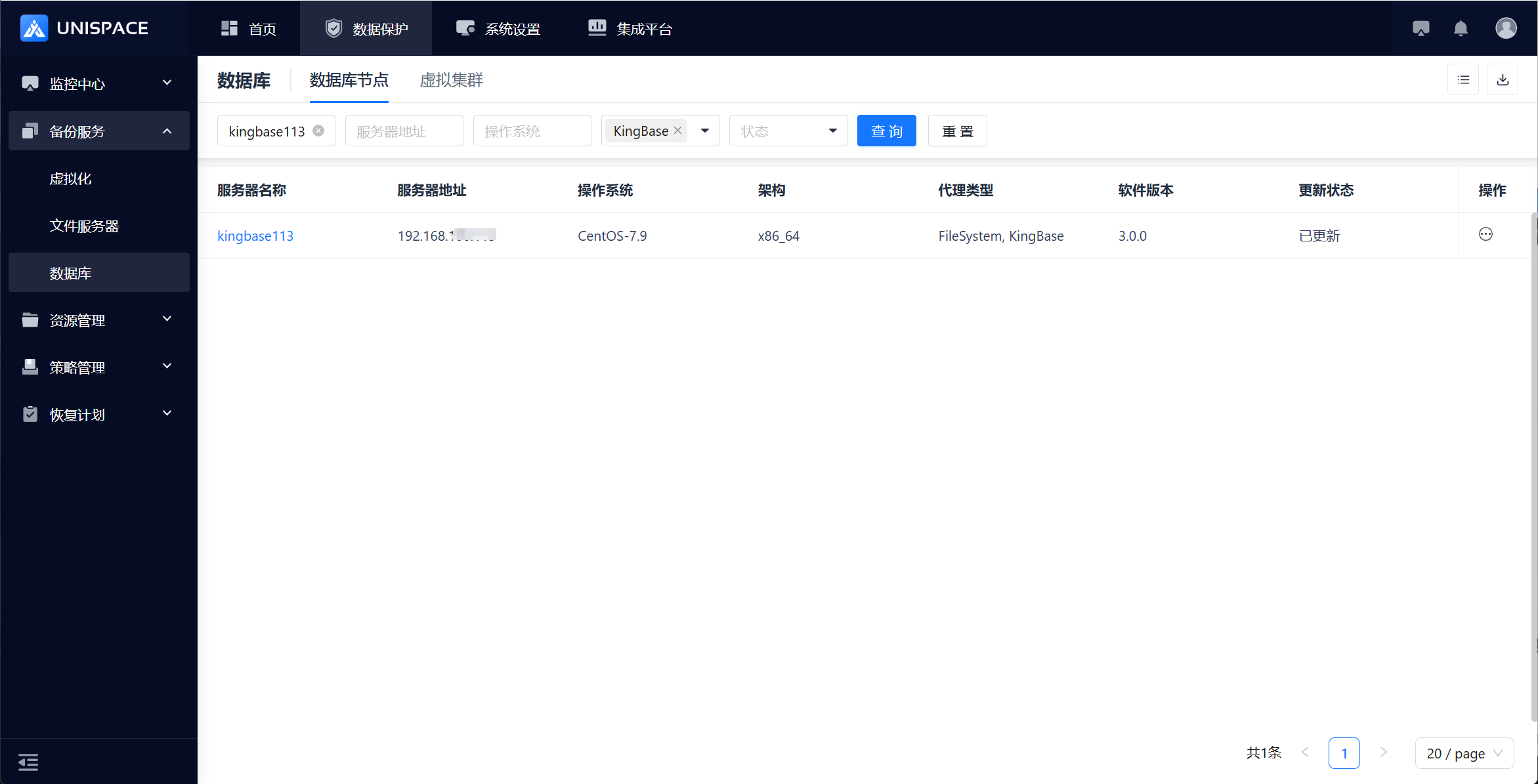
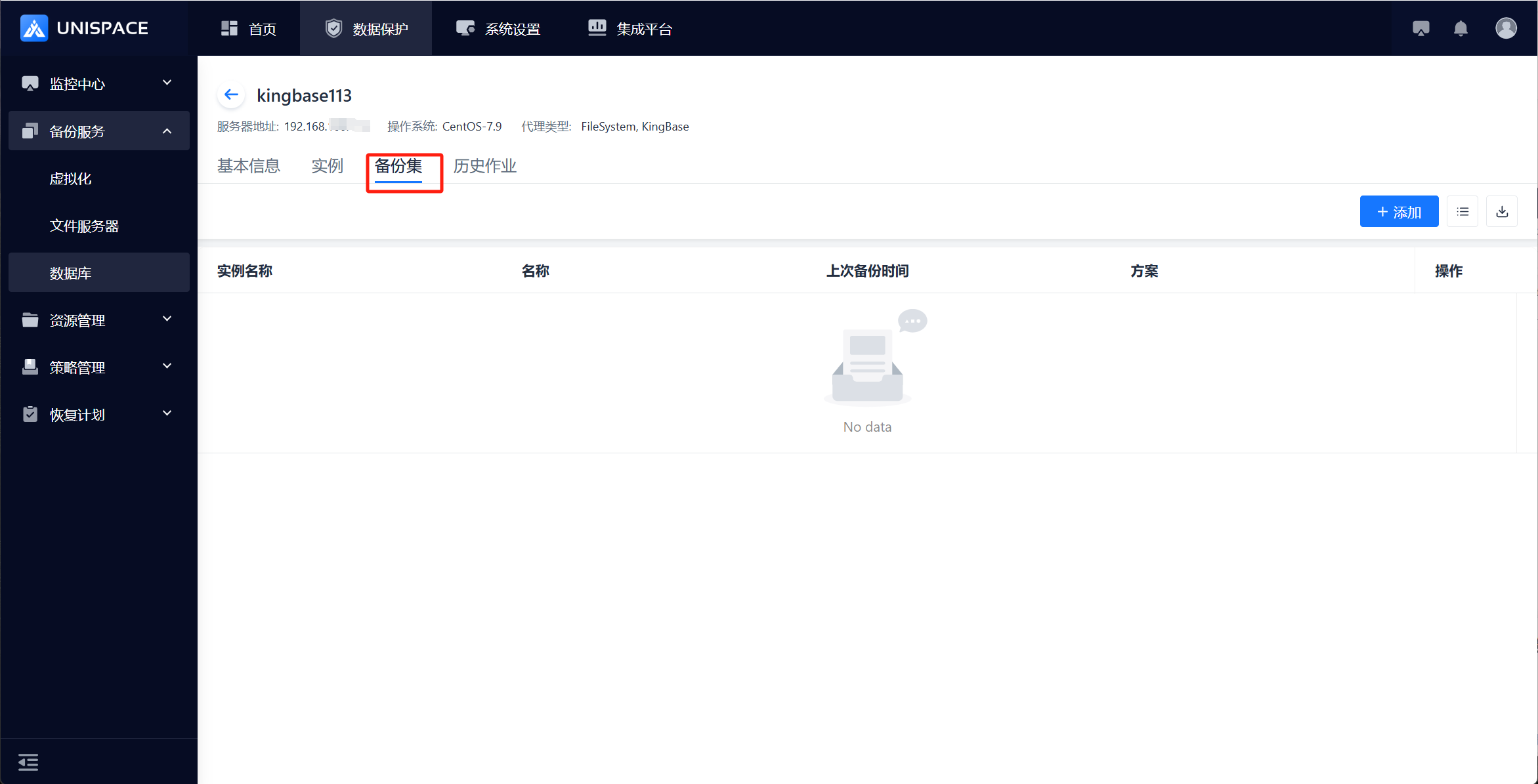 Step 2: Click the Add button on the top right of Add Backup Set to open the dialog box.
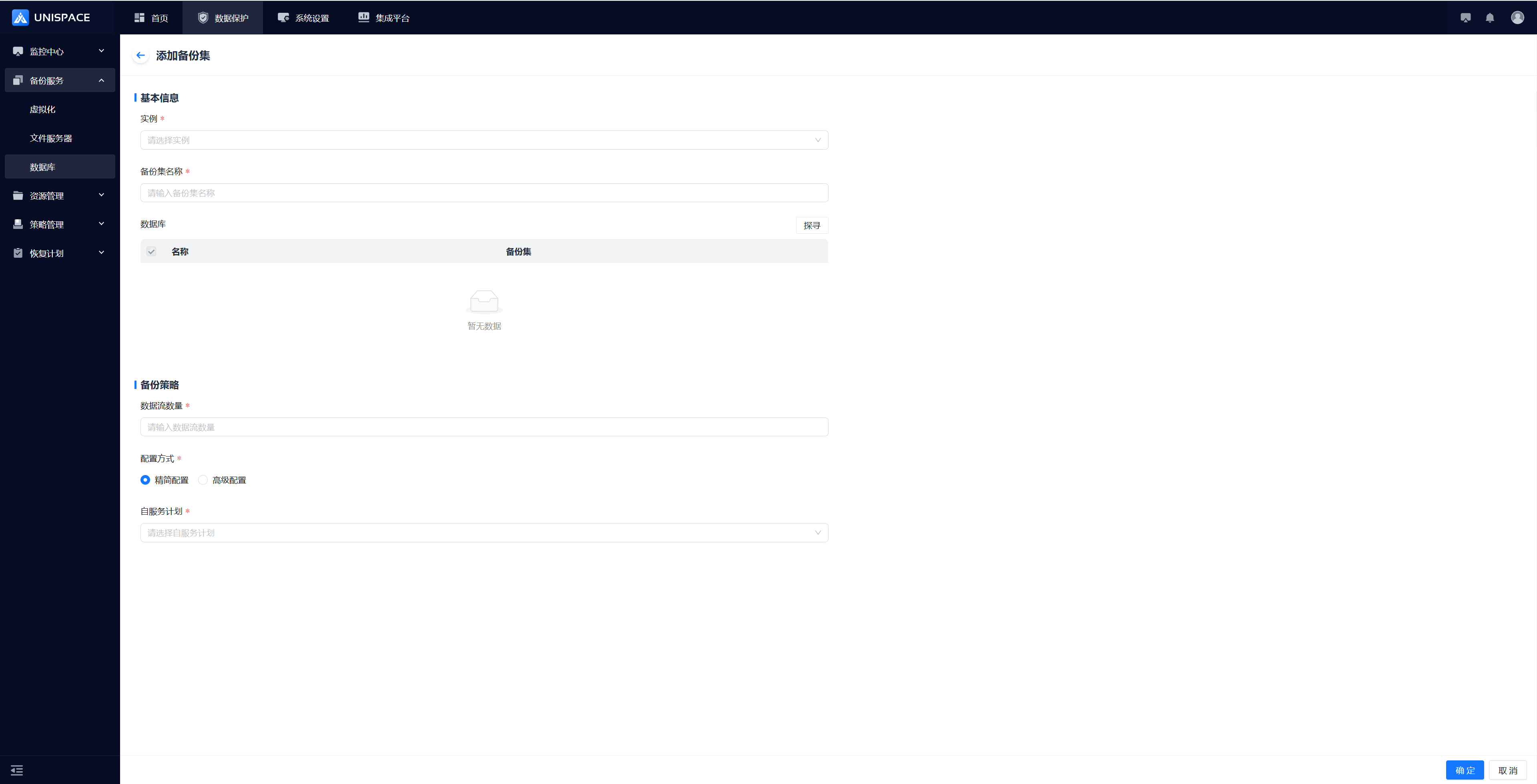 Step 3: Fill in the necessary parameters as follows:
| Parameter Name | Description | Configuration Principle |
|---|---|---|
| Instance | Dropdown, required | Select the already added Kingbase instance |
| Backup Set Name | Text input box, required | No more than 50 characters, special characters not supported |
| Backup Mode | Database Backup or Full Instance Backup | Database Backup: Select one or more databases (existing backup sets are grayed out); Instance Backup: Default selection of all databases |
| Data Stream Count | Numeric type | Full instance backup supports single stream (count: 1); Database backup supports multi-stream, max value: 200, recommended: 4 |
| Configuration Type | Dropdown, required | Simplified or Advanced configuration |
| Service Plan | Dropdown, required | Select the appropriate plan |
Step 4: Click OK to complete the process. The frontend will display a success message indicating that the backup set has been created.
1.3 Kingbase Instance Backup
Prerequisites
- Configured Kingbase instance backup set.
Steps
Step 1: Click Backup Service - Database - Server Name - Backup Set from the system menu.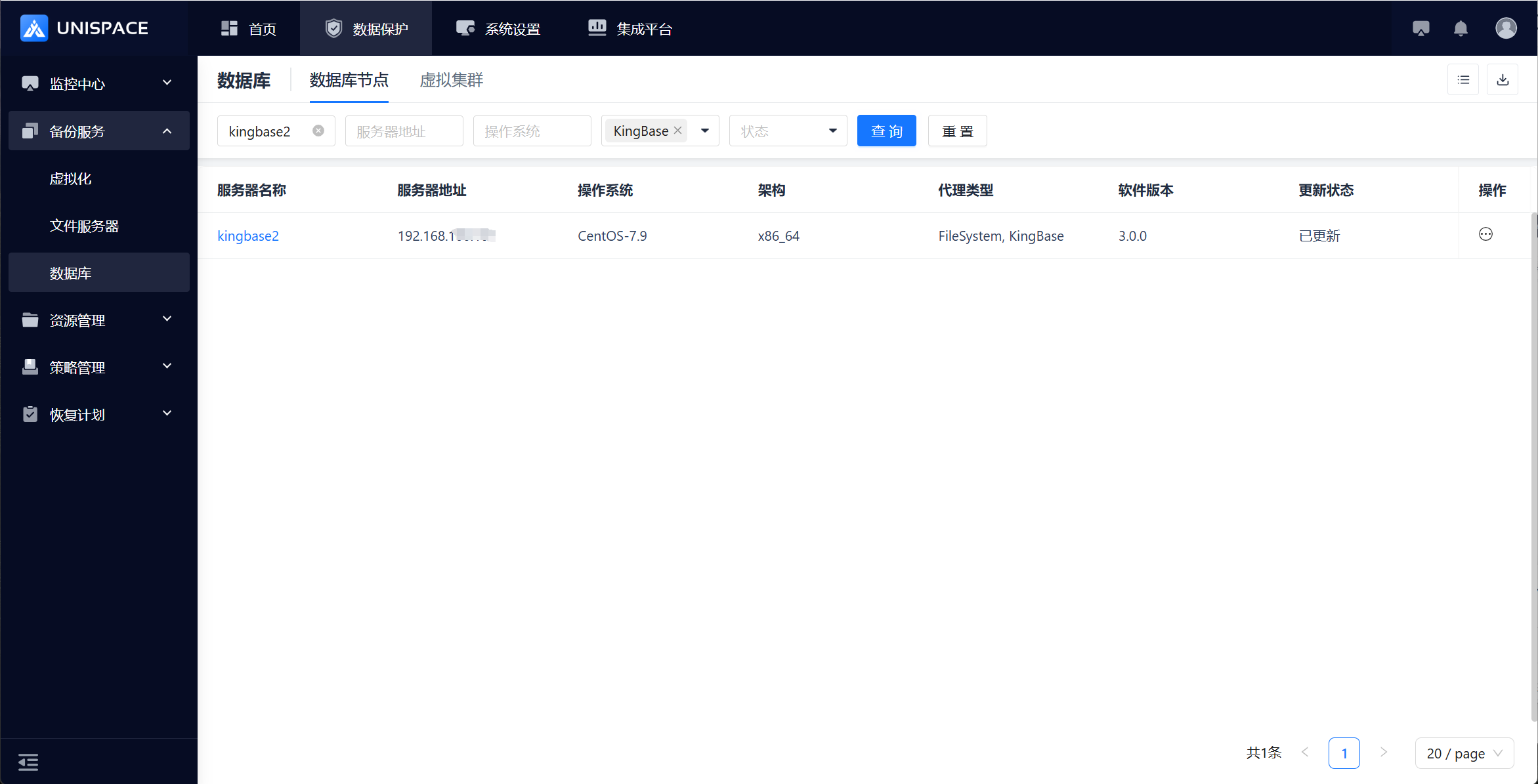
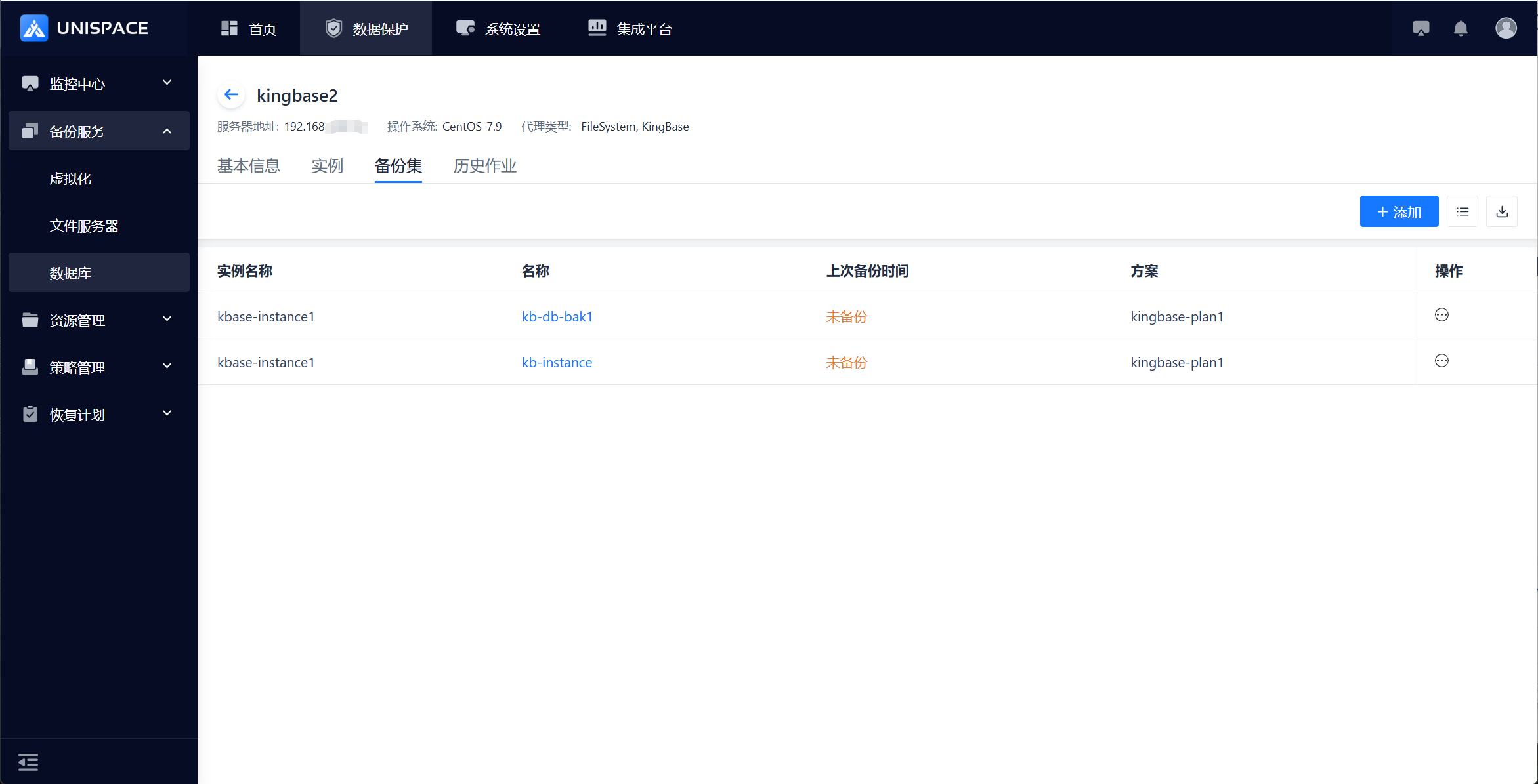
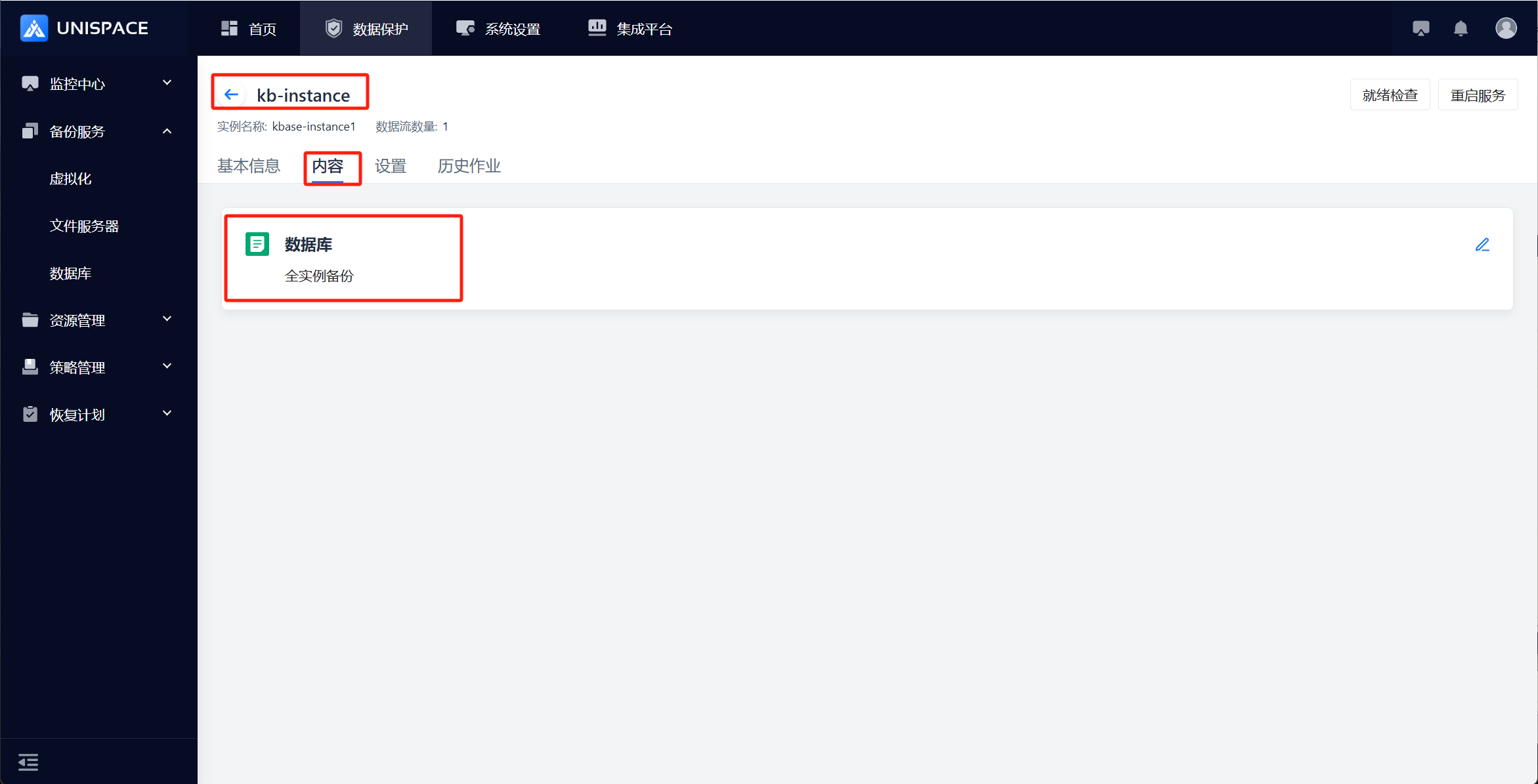 Step 2: Select the instance backup set, click Operations in the list and select Backup, then choose Full from the popup.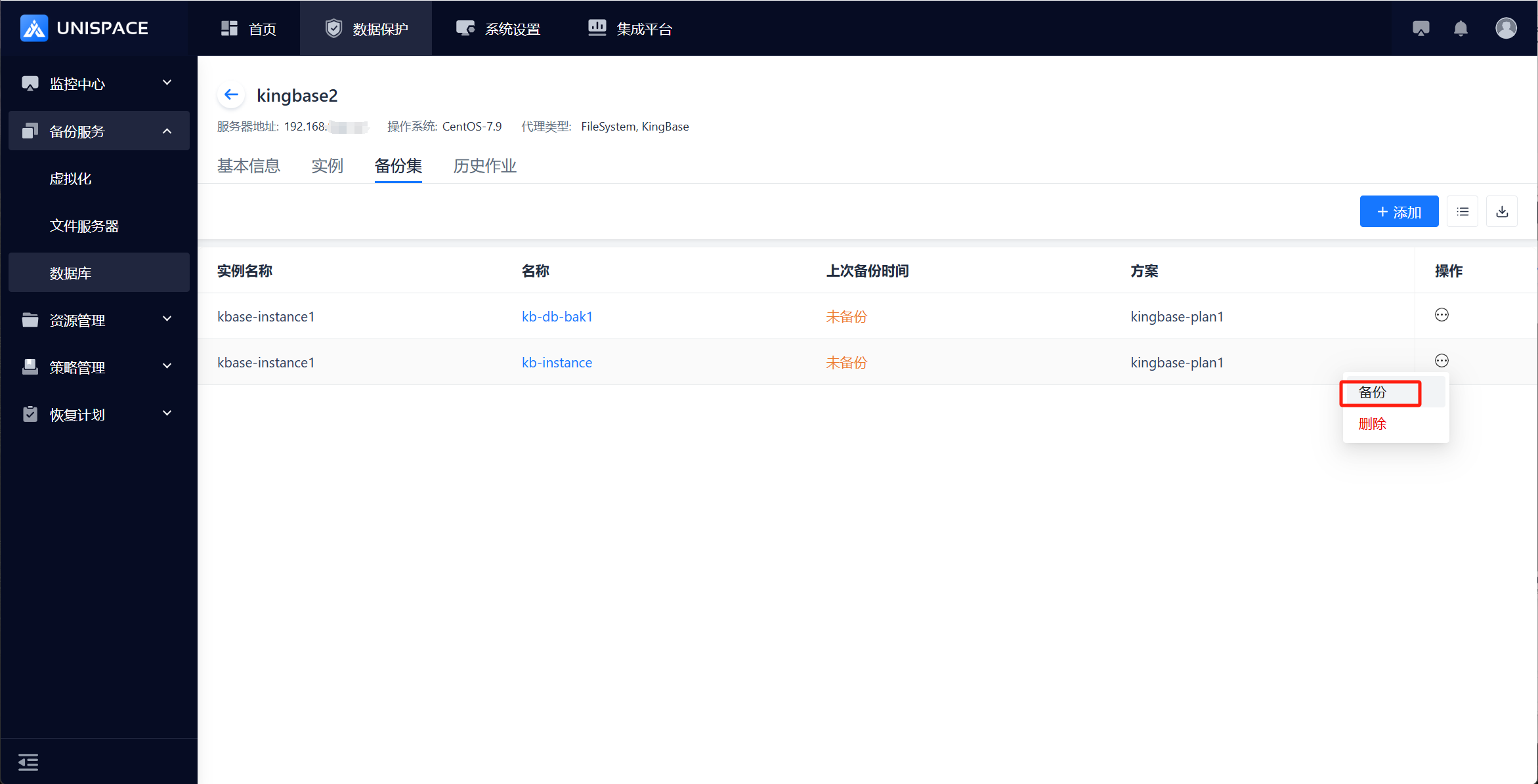
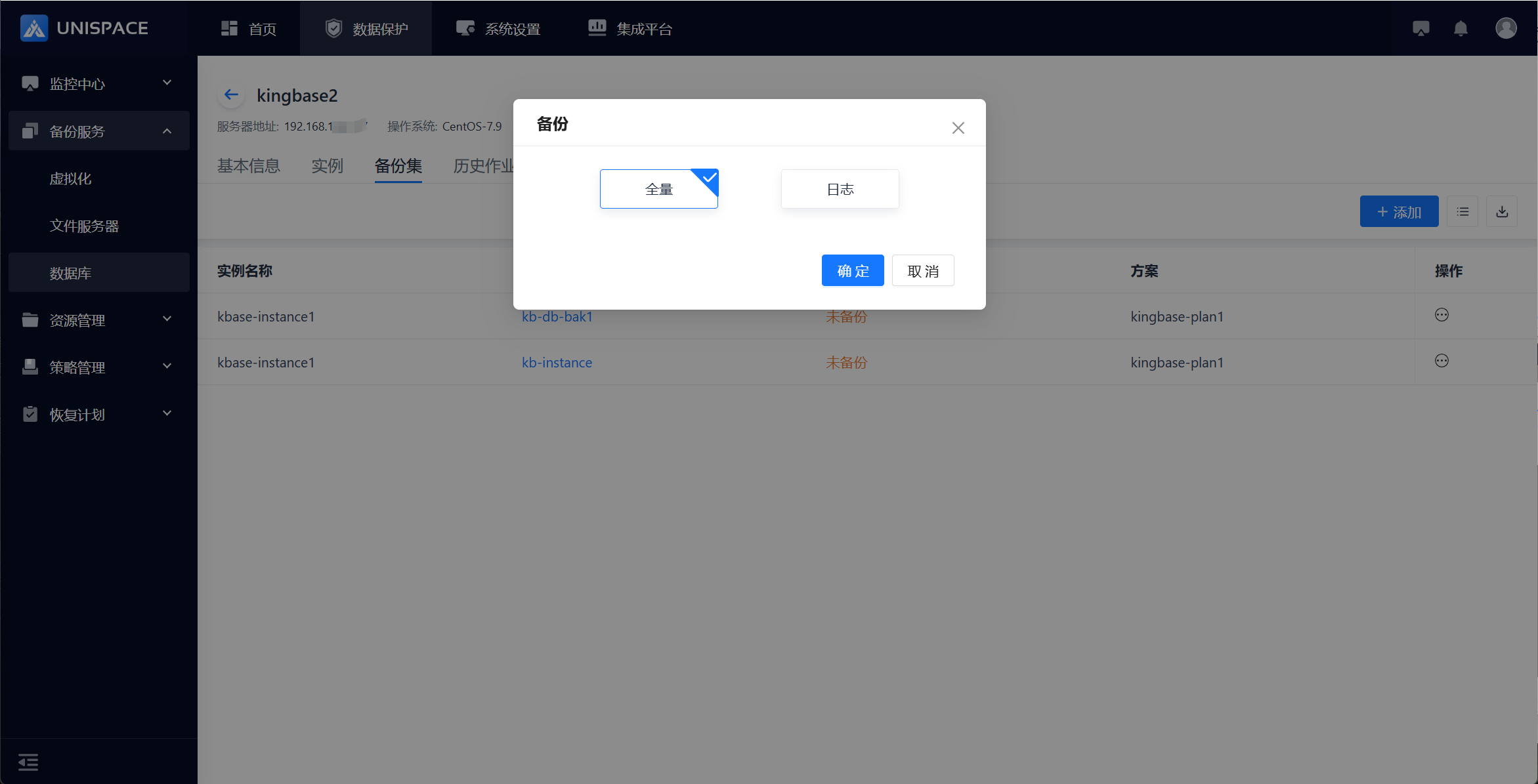 Step 3: Select Database and click OK. A message will appear stating "Backup job submitted successfully".
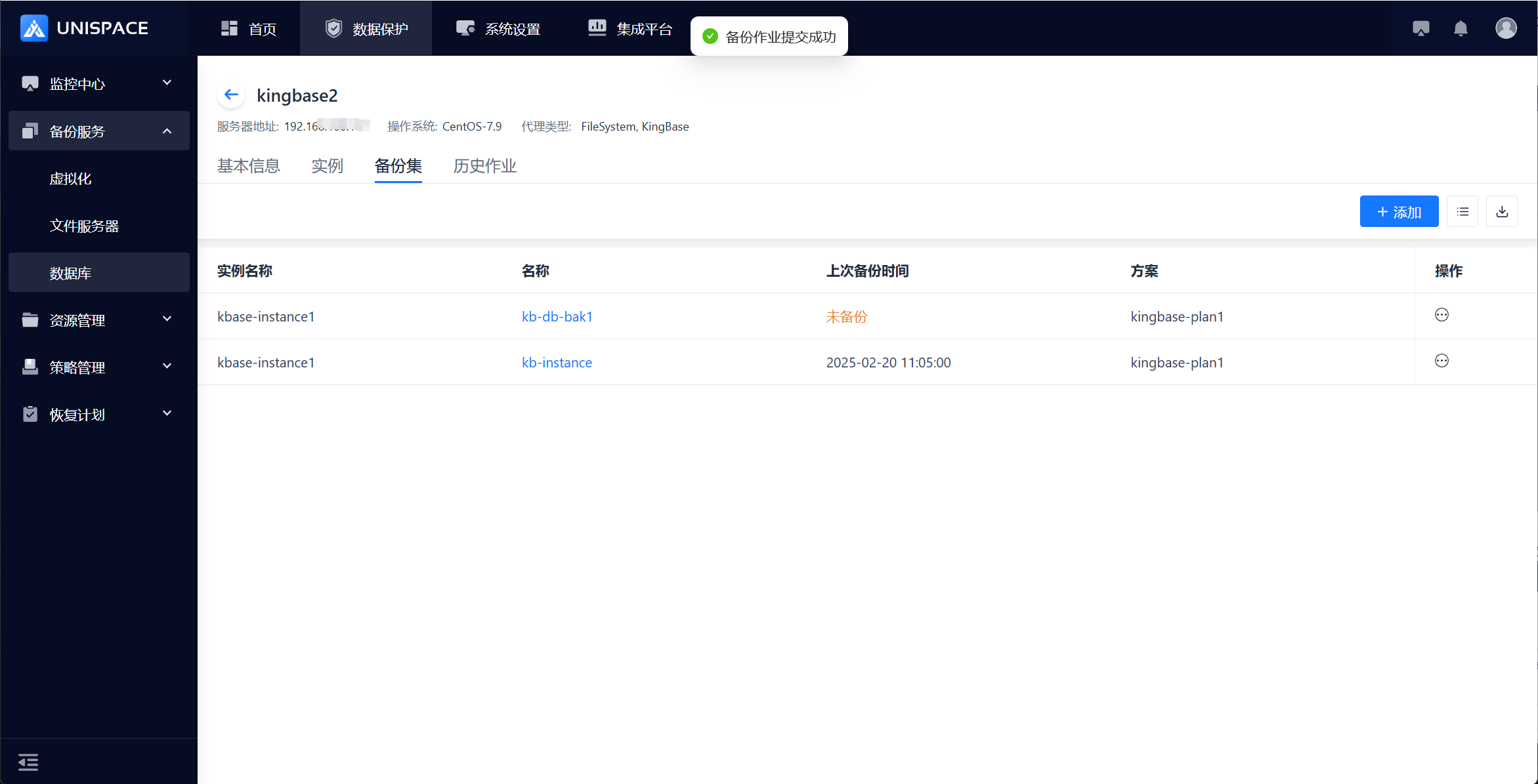 Step 4: After the backup job starts, go to Monitoring Center - Jobs - Active Jobs to view the backup job.
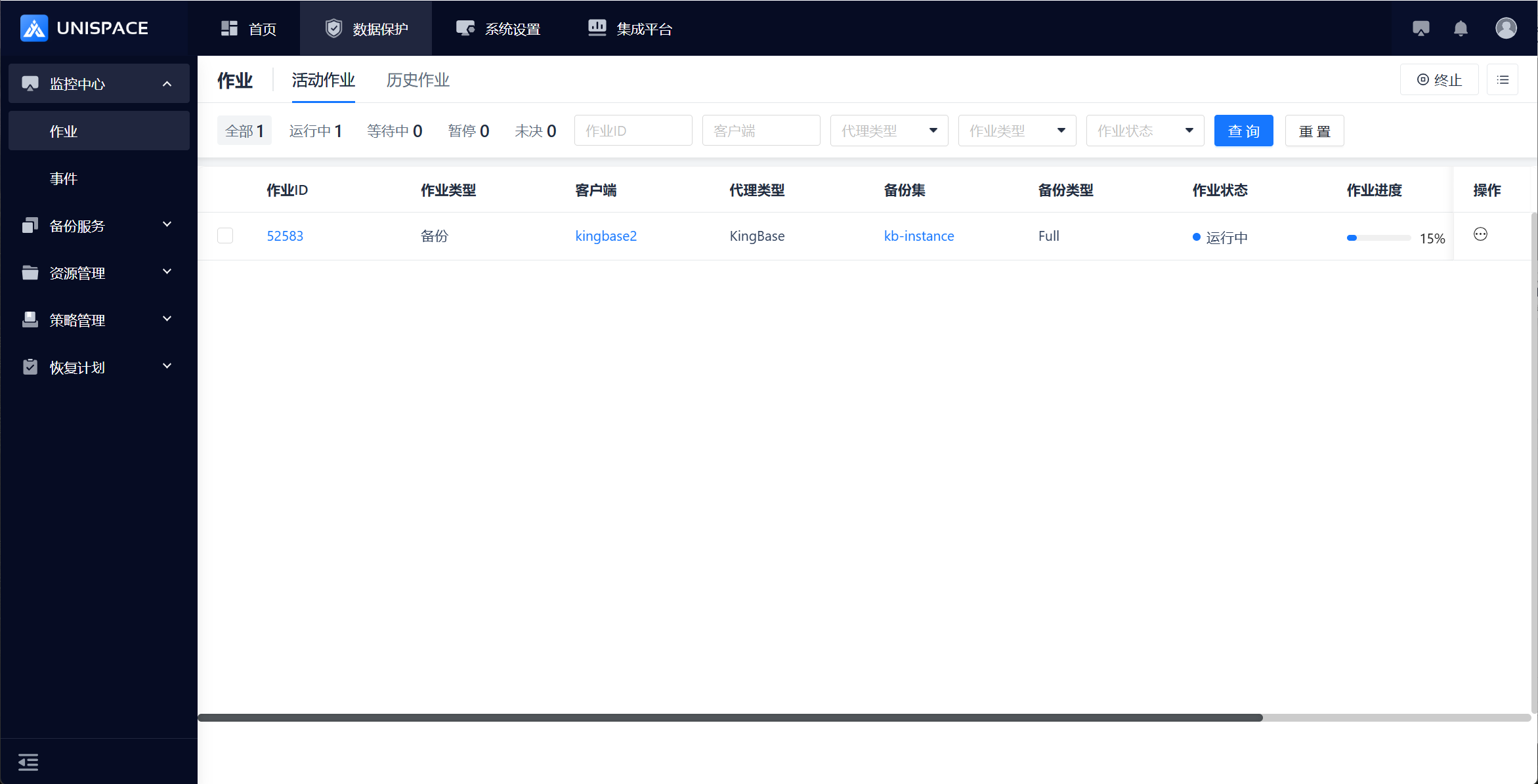 Step 5: Once completed, go to Monitoring Center - Jobs - Job History to see the backup job status marked as "Completed".
1.4 Kingbase Log Backup
Prerequisites
- Configured Kingbase instance backup set.
Steps
Step 1: Click Backup Service - Database - Server Name - Backup Set from the system menu.Step 2: Select the instance backup set, click Operations in the list and select Backup, then choose Log from the popup.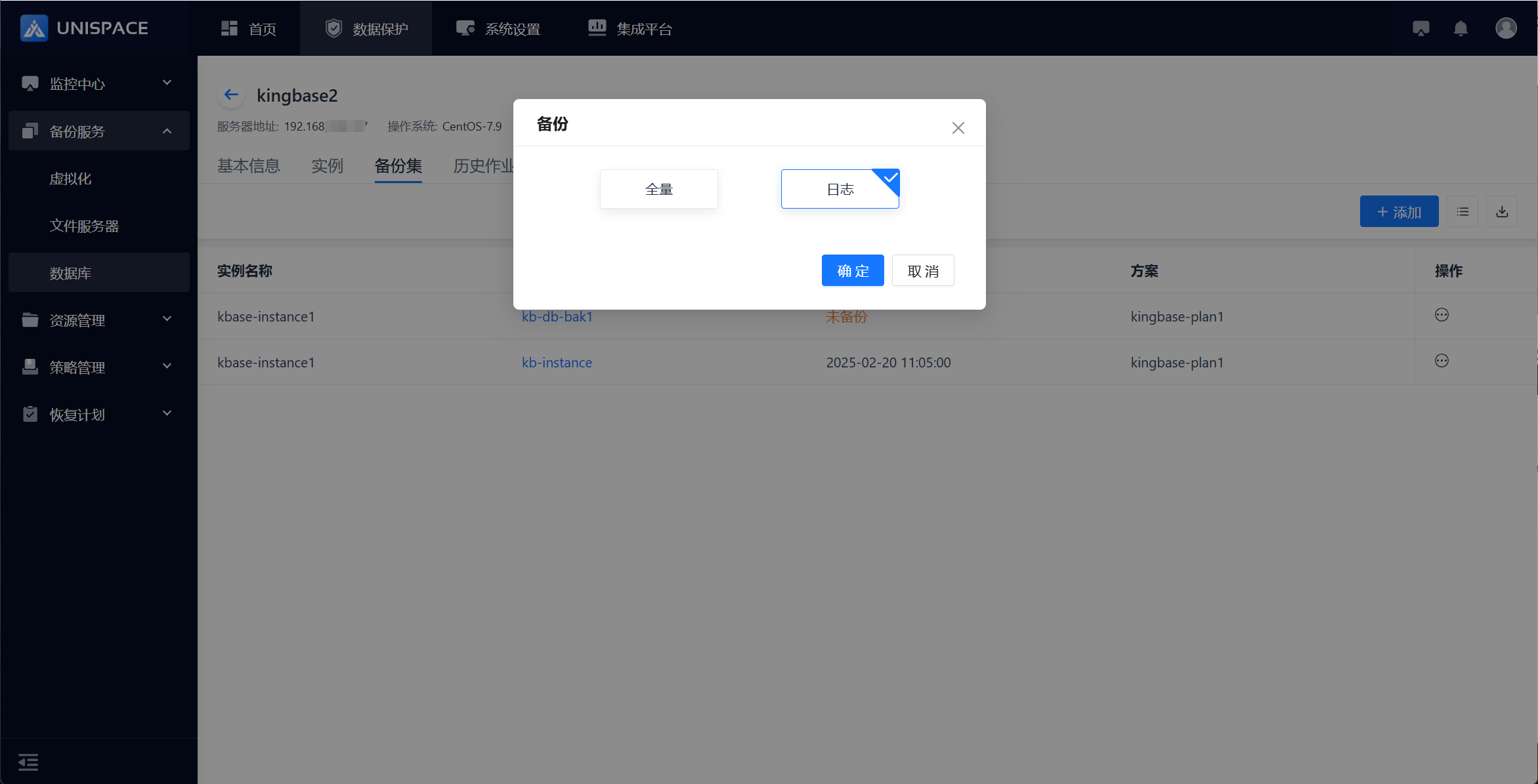 Step 3: Select Database and click OK. A message will appear stating "Backup job submitted successfully".
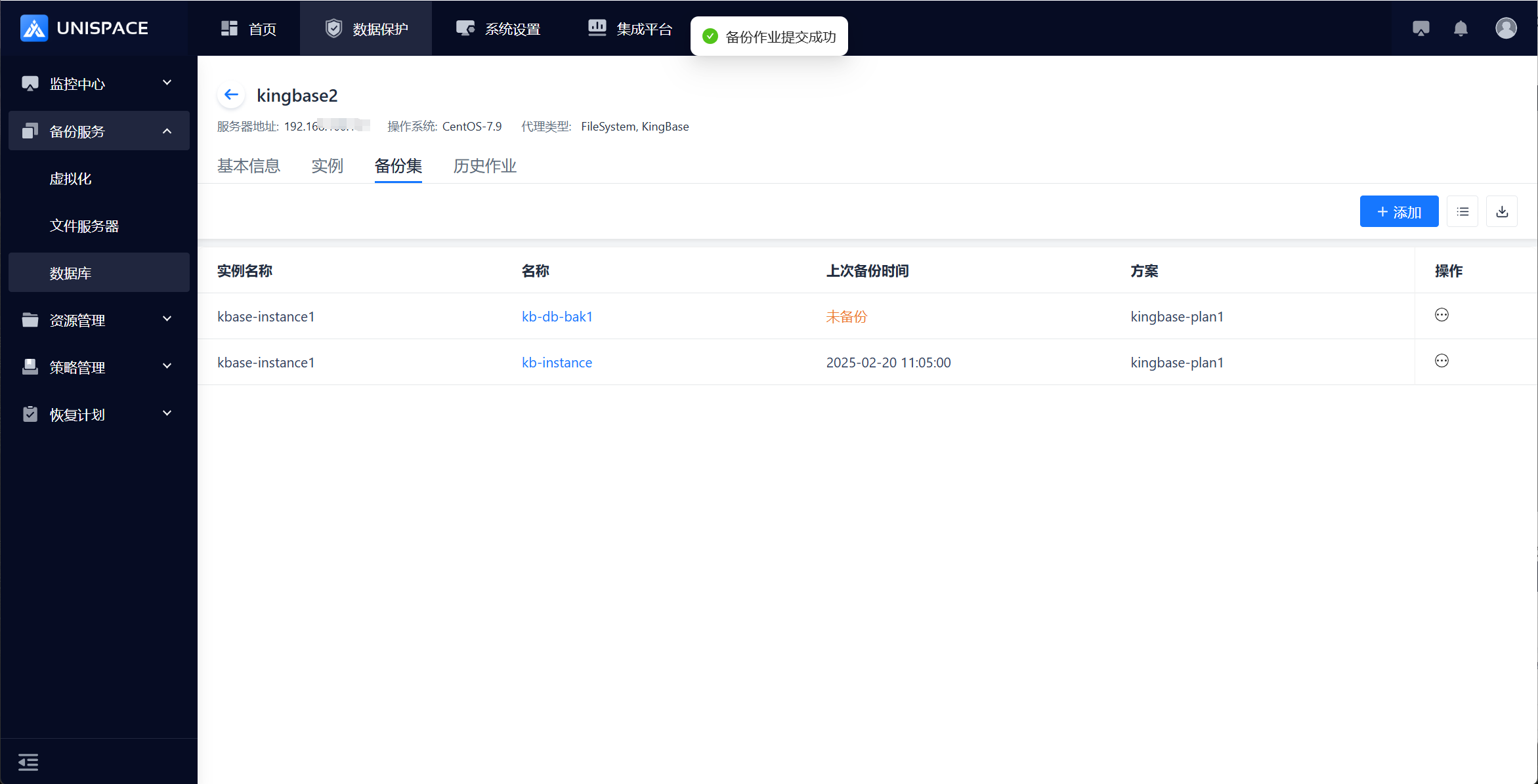 Step 4: After the backup job starts, go to Monitoring Center - Jobs - Active Jobs to view the log backup job.Step 5: Once completed, go to Monitoring Center - Jobs - Job History to see the log backup job status marked as "Completed".
1.5 Kingbase Database Backup
Prerequisites
- Configured Kingbase database backup set.
Steps
Step 1: Click Backup Service - Database - Server Name - Backup Set from the system menu.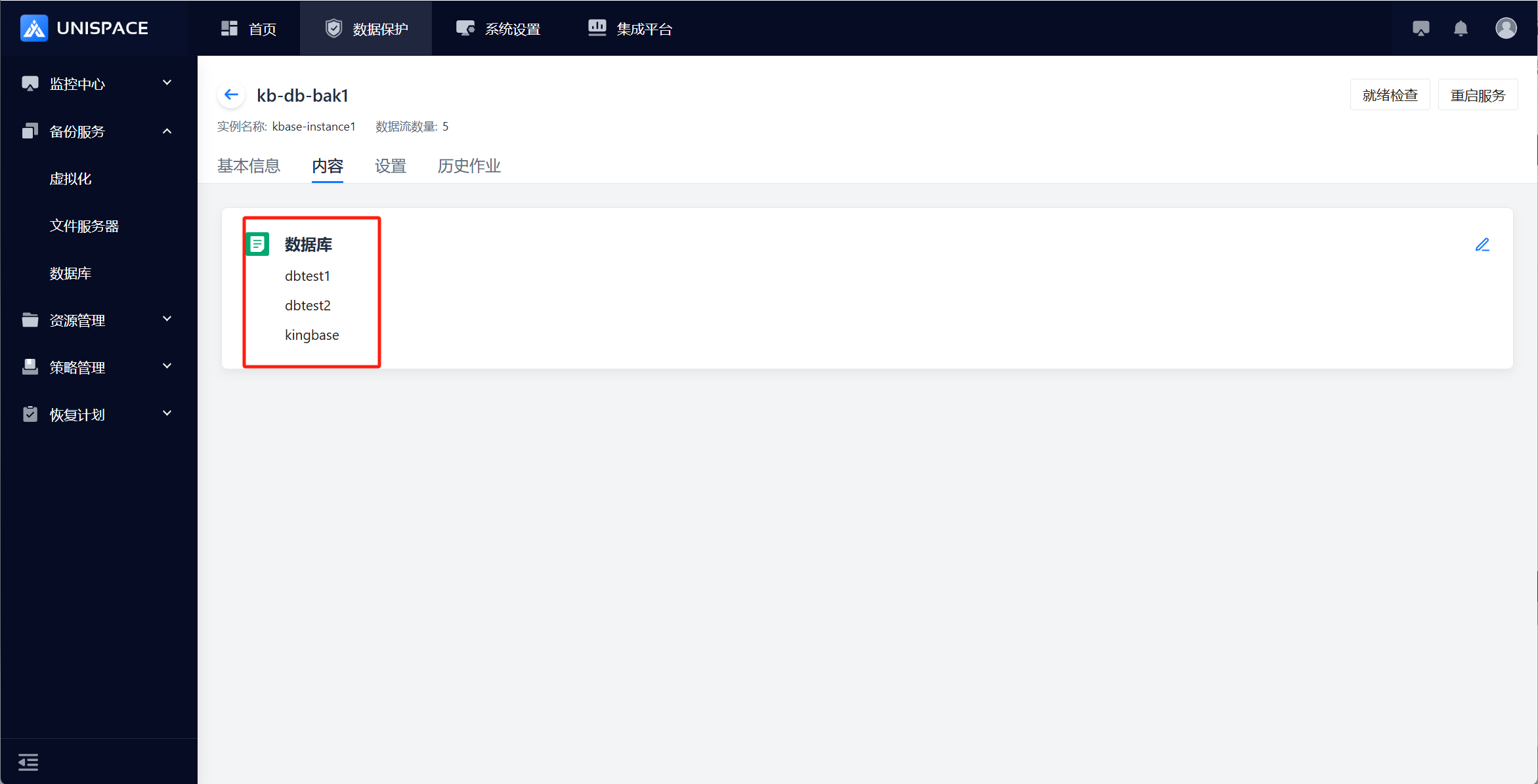 Step 2: Select the instance backup set, click Operations in the list and select Backup, then choose Full from the popup.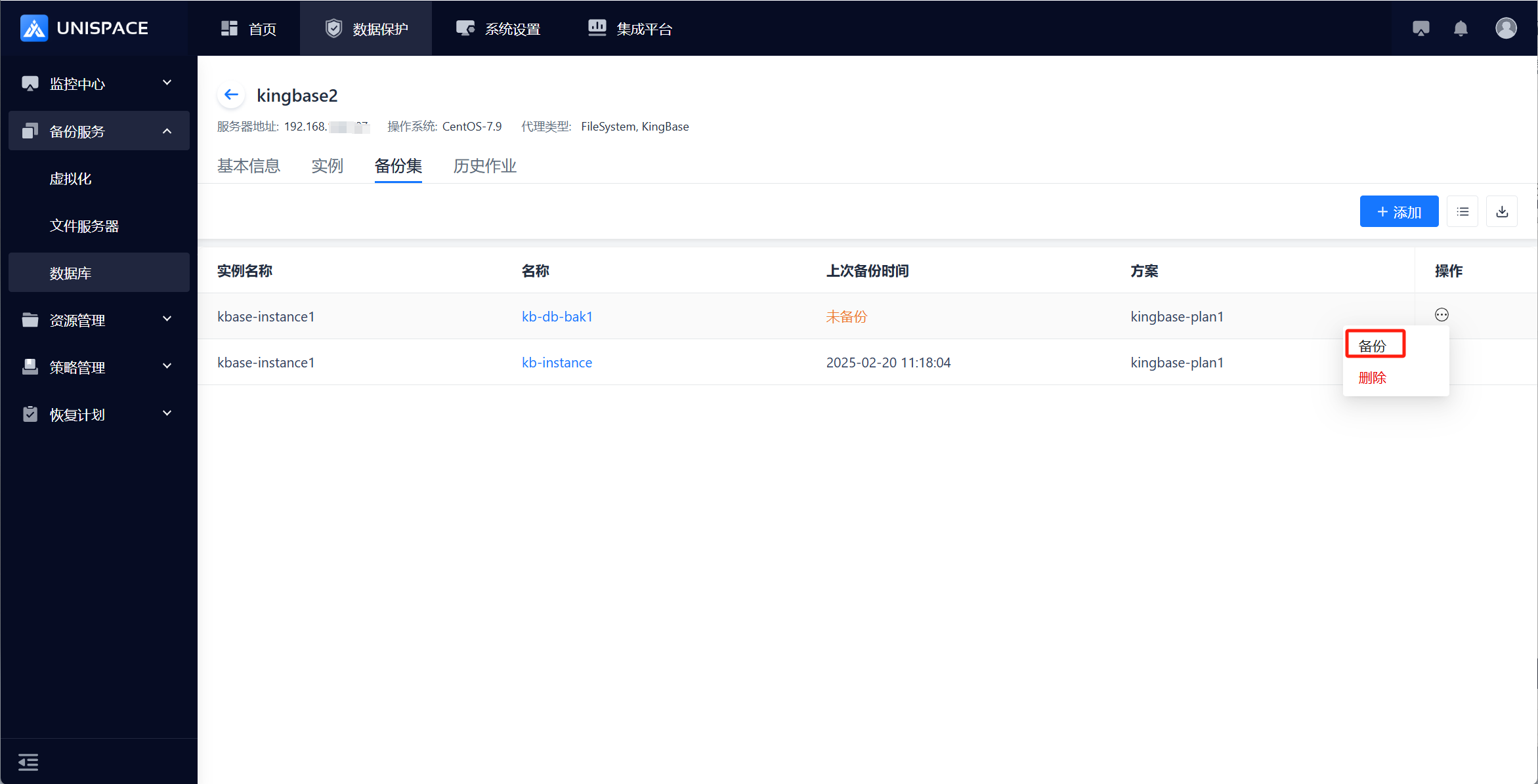
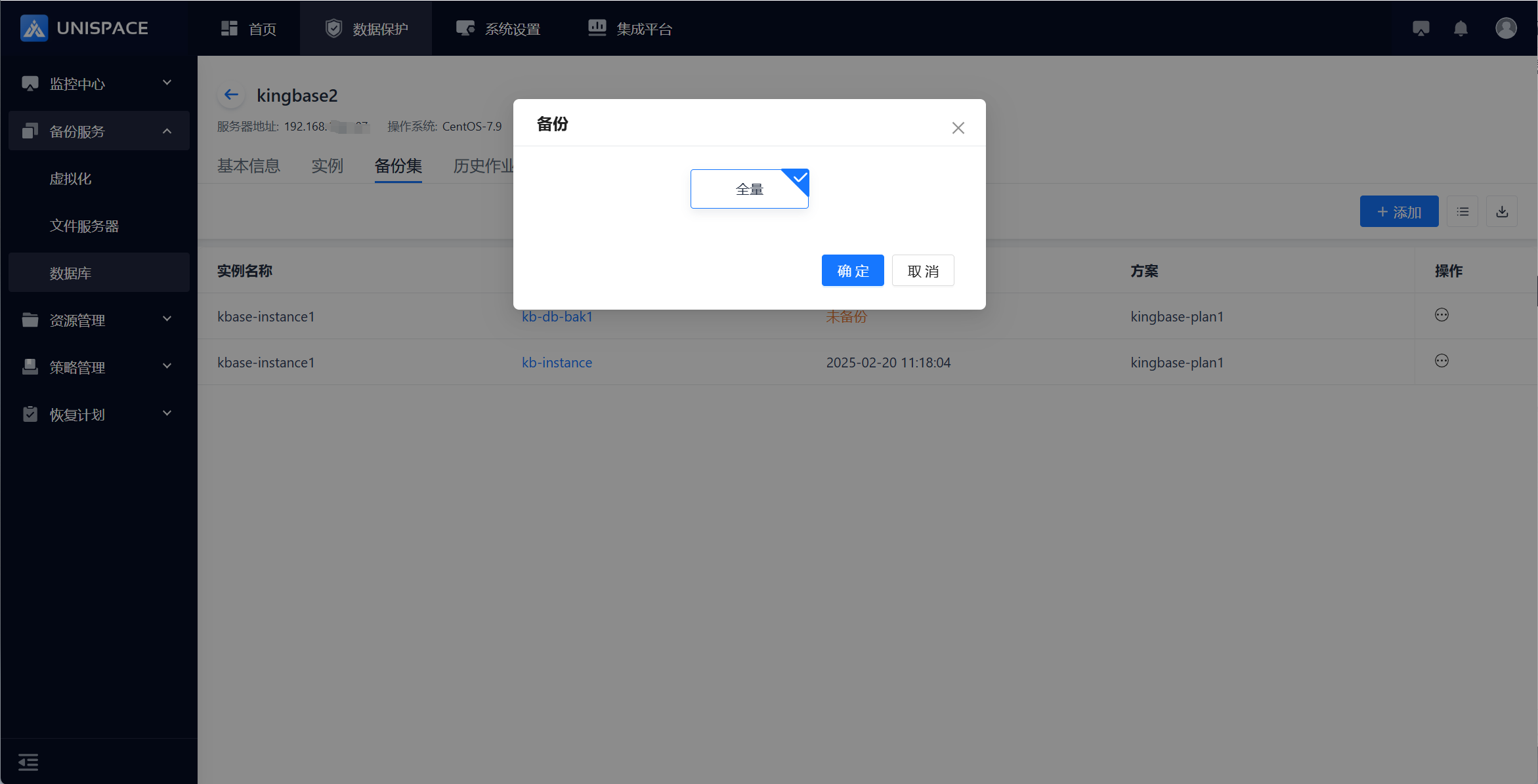 Step 3: Select Database and click OK. A message will appear stating "Backup job submitted successfully".Step 4: After the backup job starts, go to Monitoring Center - Jobs - Active Jobs to view the database backup job.
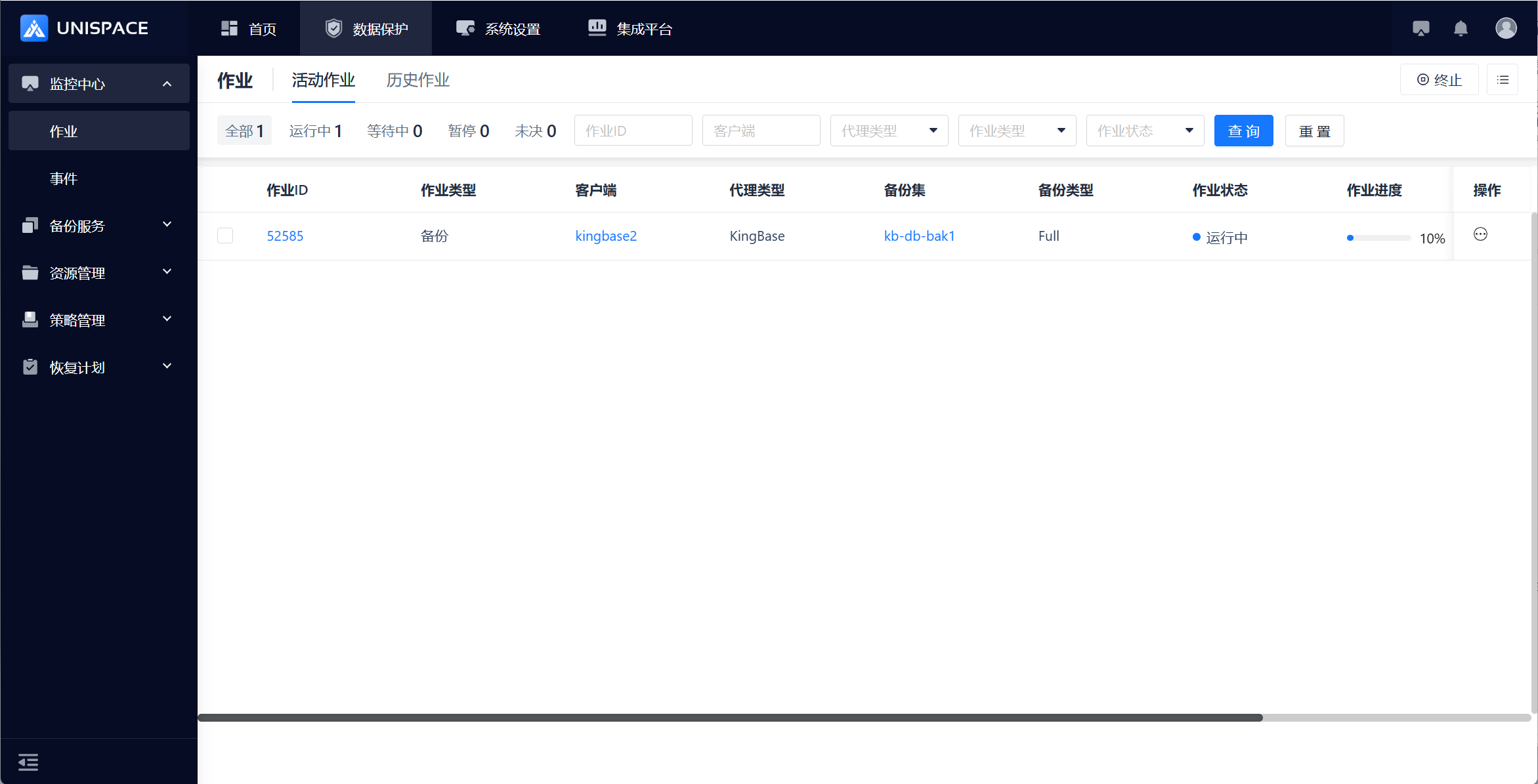 Step 5: Once completed, go to Monitoring Center - Jobs - Job History to see the database backup job status marked as "Completed".
1.6 Kingbase Database Recovery
Prerequisites
- A backup of the Kingbase database has been created.
- System databases are not supported for recovery.
Steps
Step 1: Click Backup Service - Database - Server Name - Instance from the system menu.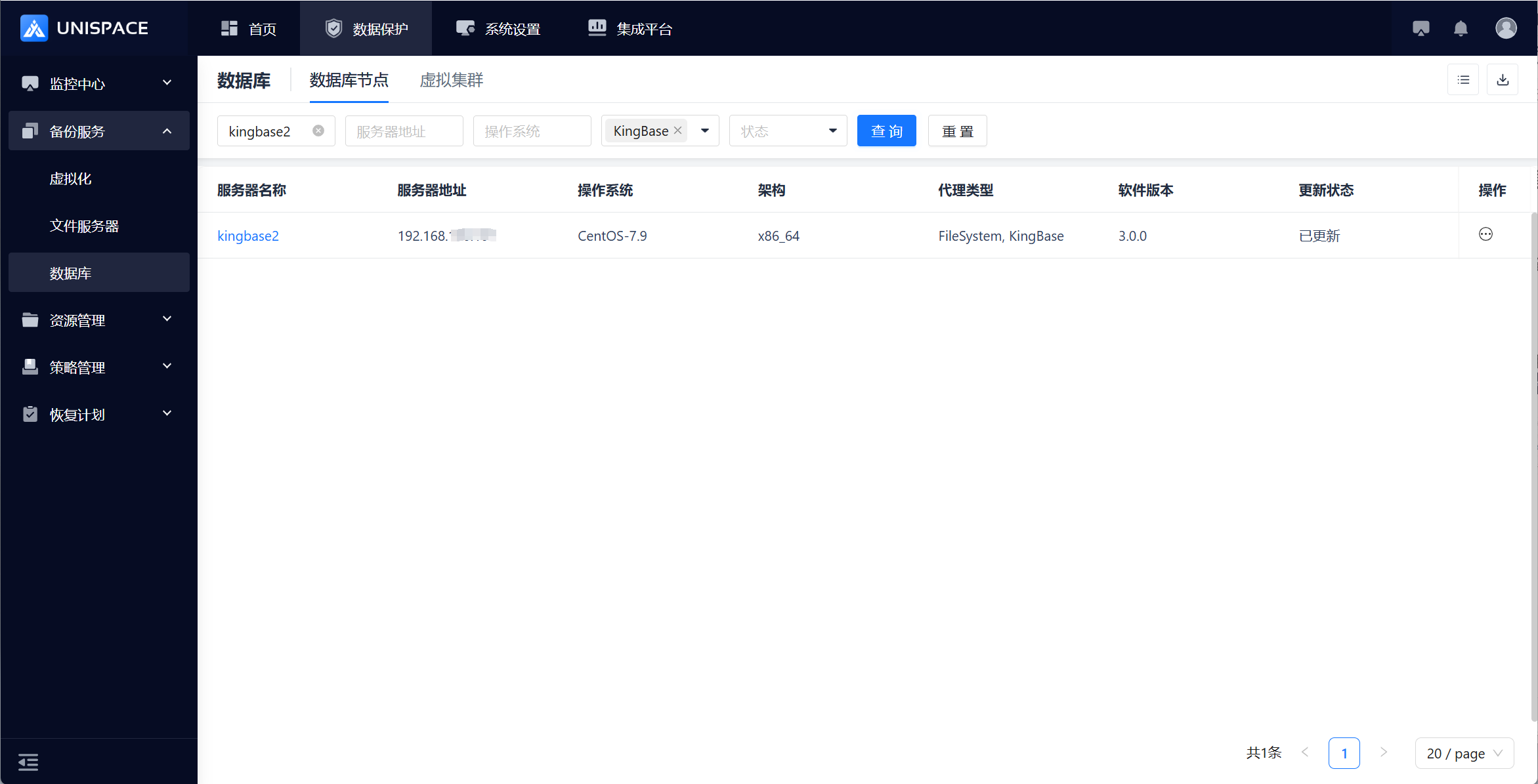 Step 2: Select Instance, click Operations in the list, select Recovery, and choose Database Recovery. Click Next.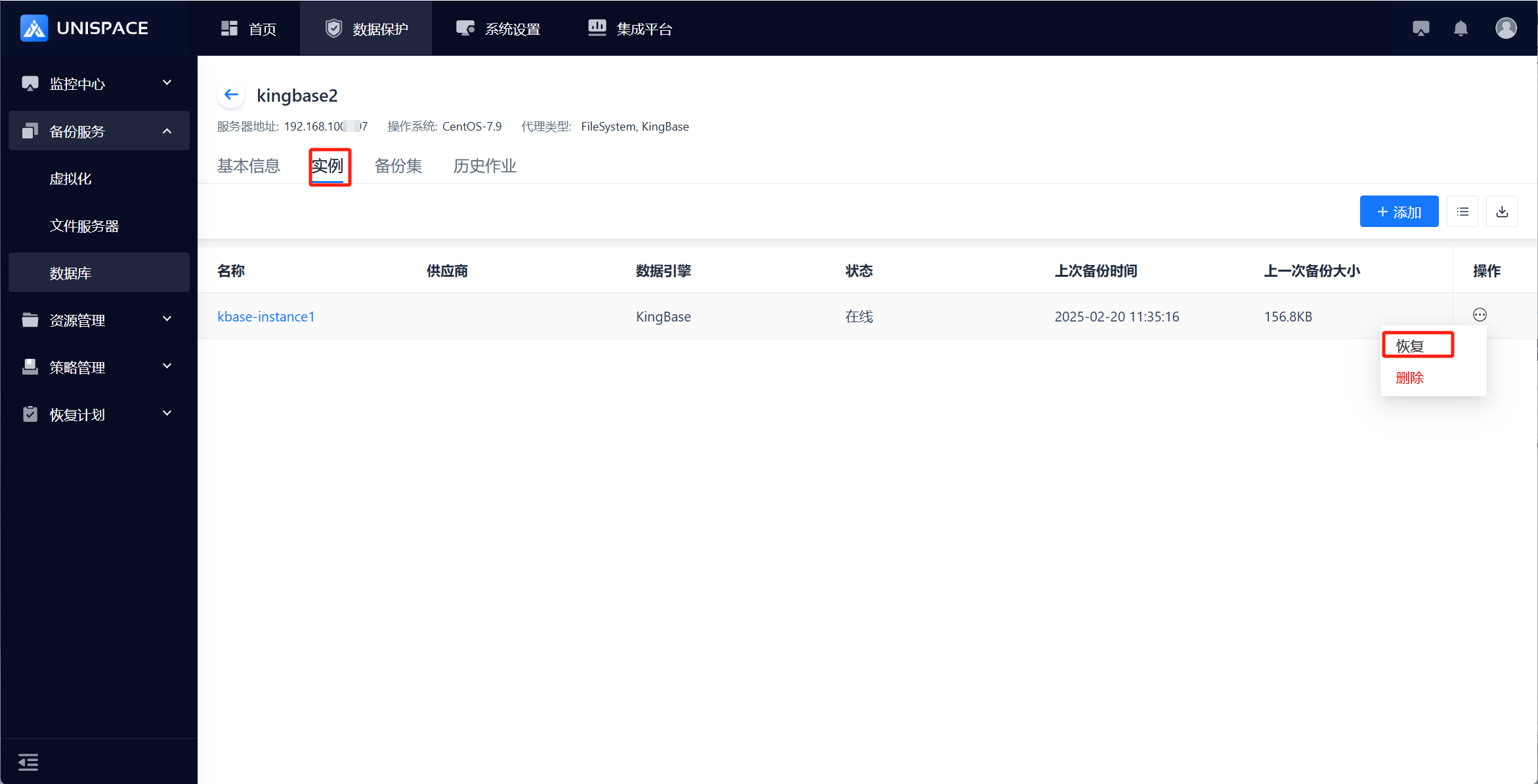
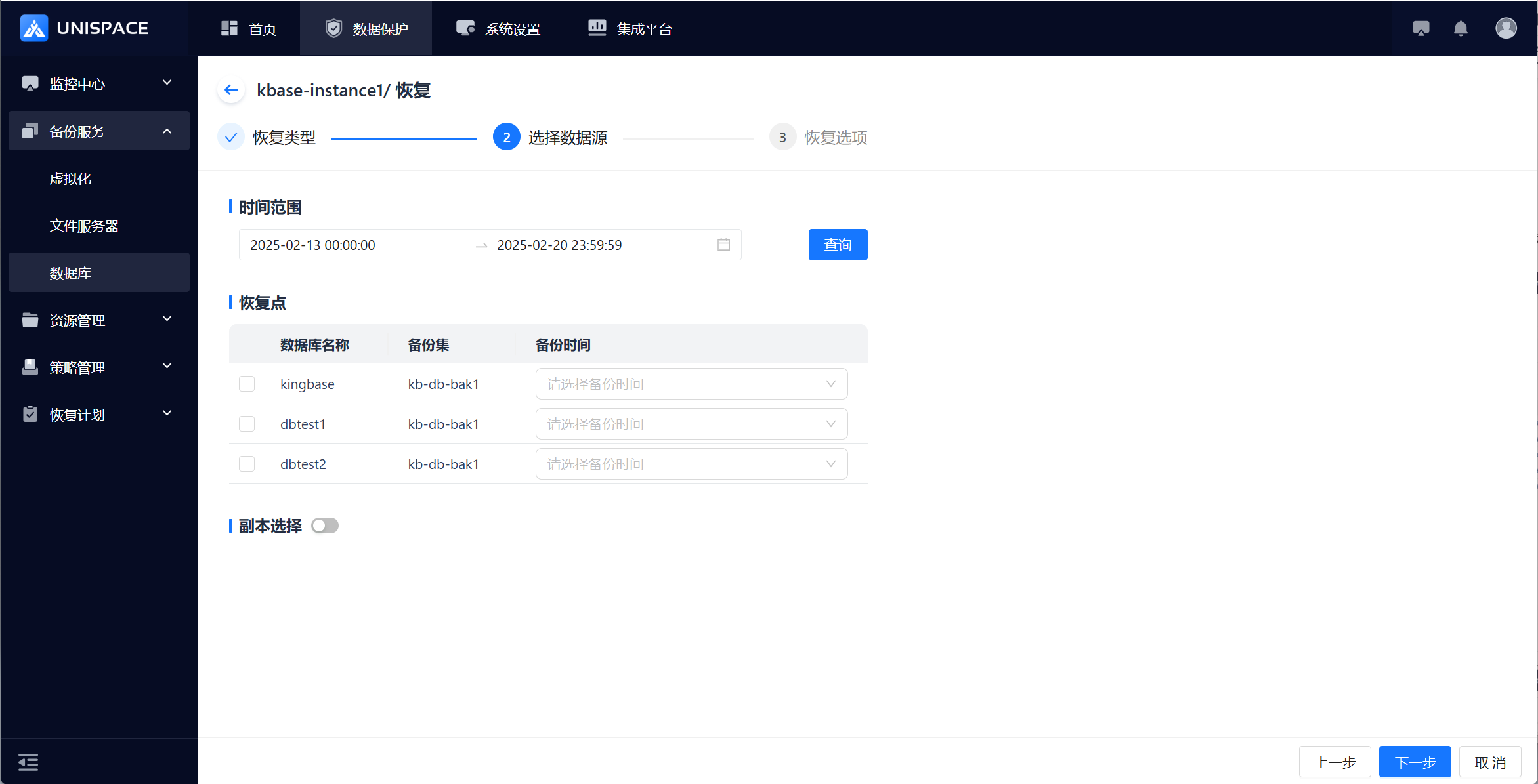
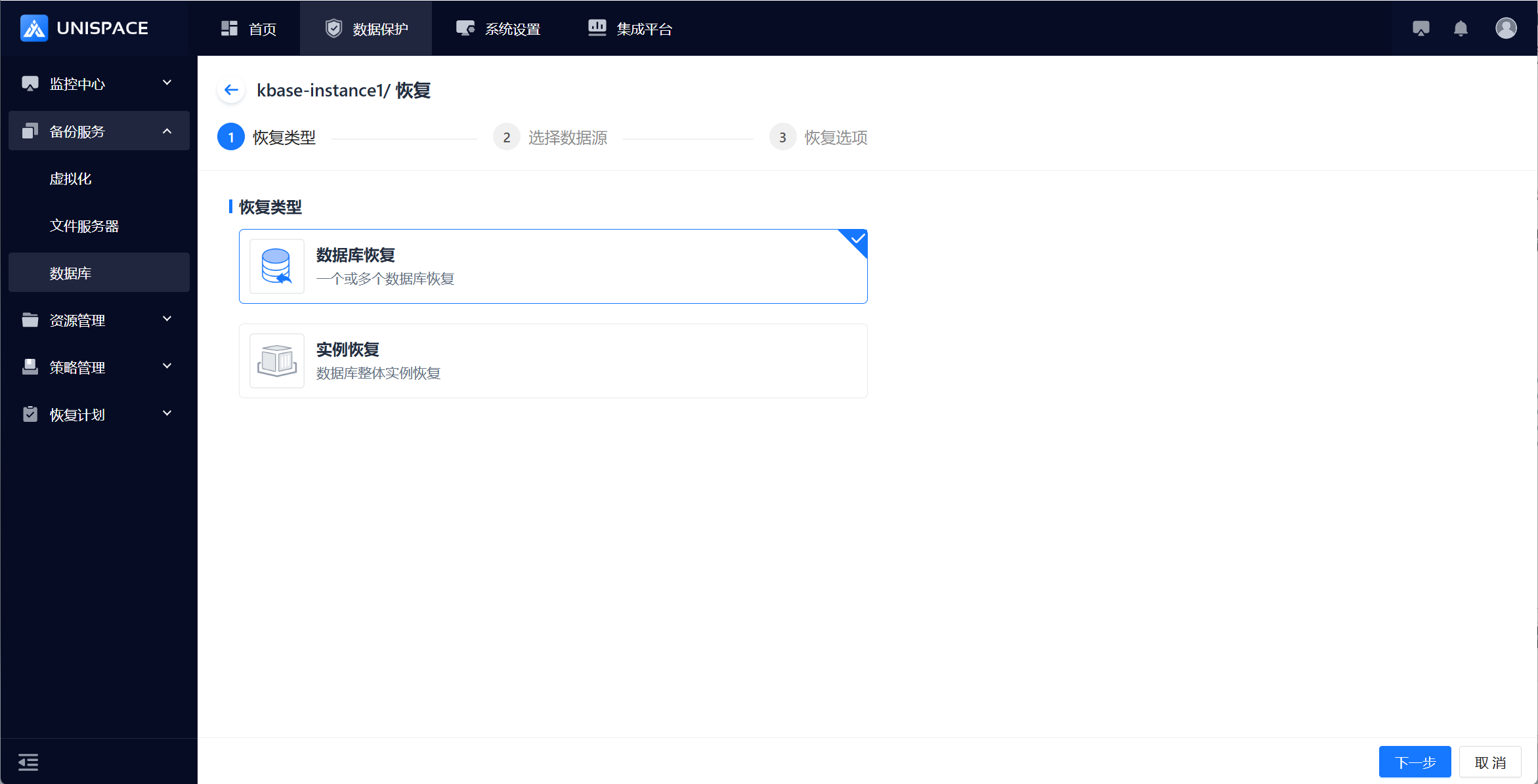 Step 3: The recovery dialog appears. Select the recovery point based on the time range to find the recovery point. Choose Database and Backup Time, then click Next (cross-backup set recovery is not supported).
 Step 4: Configure the recovery options and click OK.
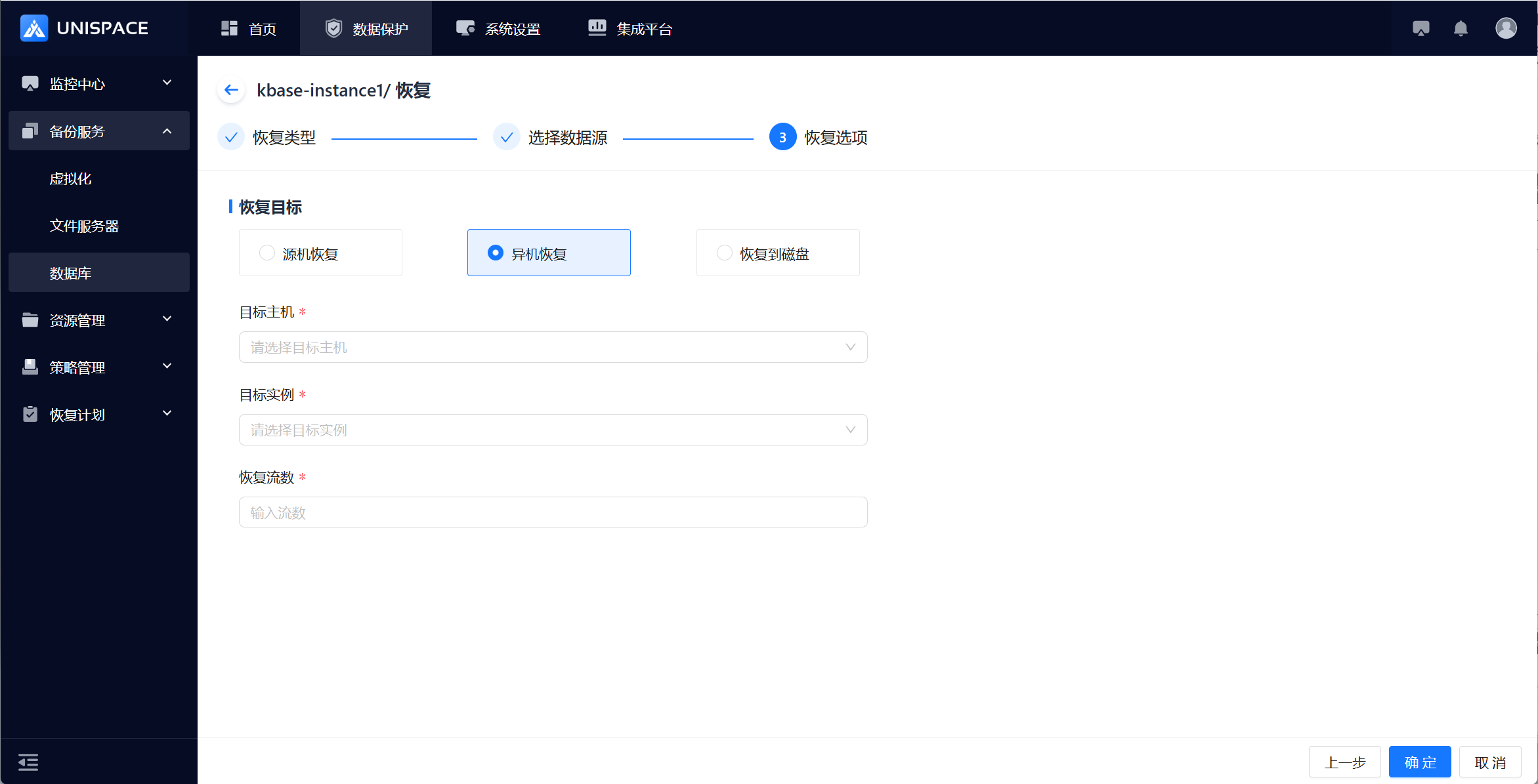 Step 5: Fill in the necessary parameters as follows:
| Parameter Name | Description | Configuration Principle |
|---|---|---|
| Recovery Target | Default: Cross-Machine Recovery | Options: Same Machine Recovery, Cross-Machine Recovery, Recovery to Disk |
| Target Host | Default: Cross-Machine Recovery, dropdown list | Select the client node where Kingbase service is installed |
| Target Instance | Automatically linked with the target host | Default to the source instance, grayed out |
| Recovery Stream | Numeric type | Maximum value: 200, recommended: 4 |
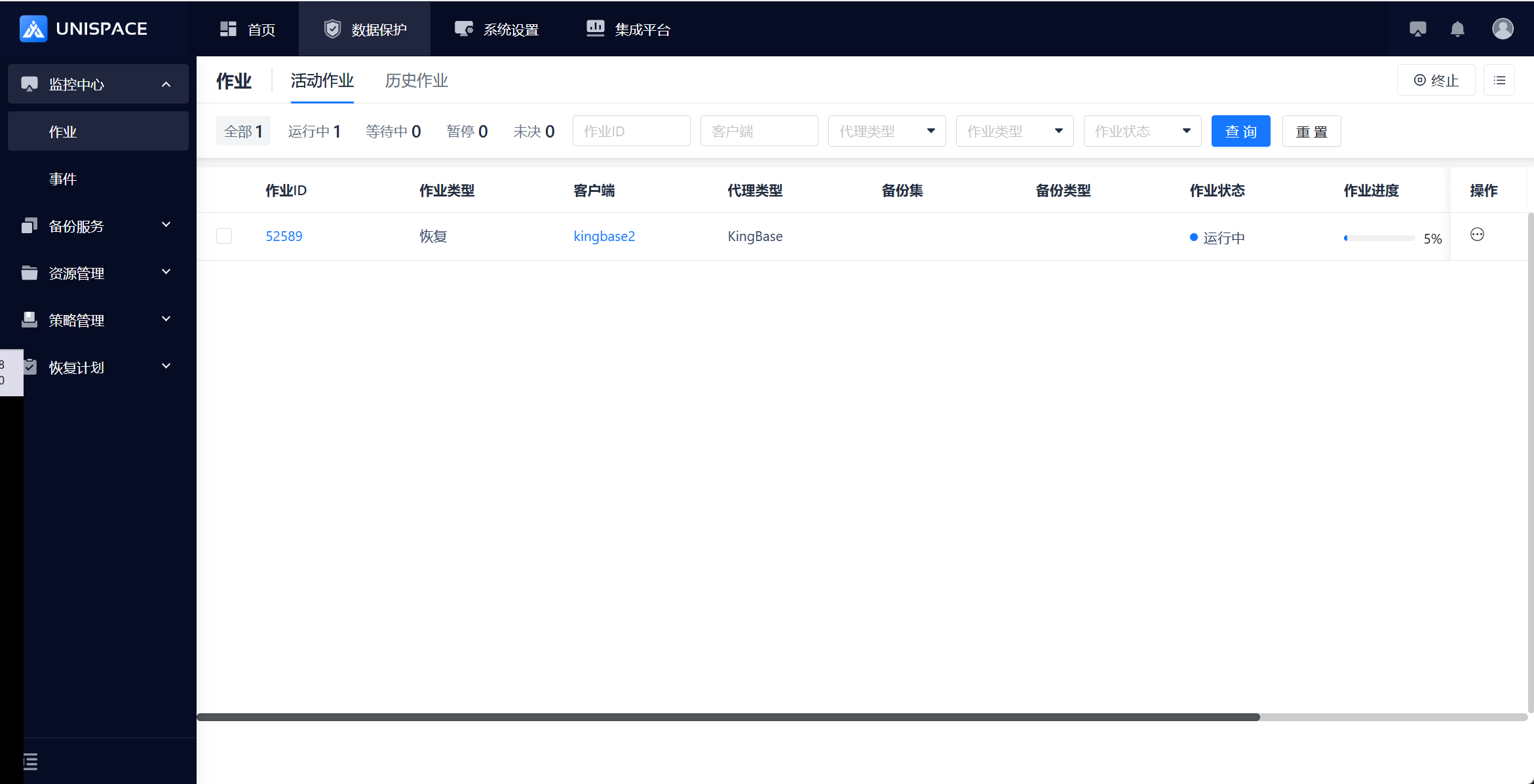
Step 6: Once the job starts, go to Monitoring Center - Jobs - Active Jobs to view the recovery job.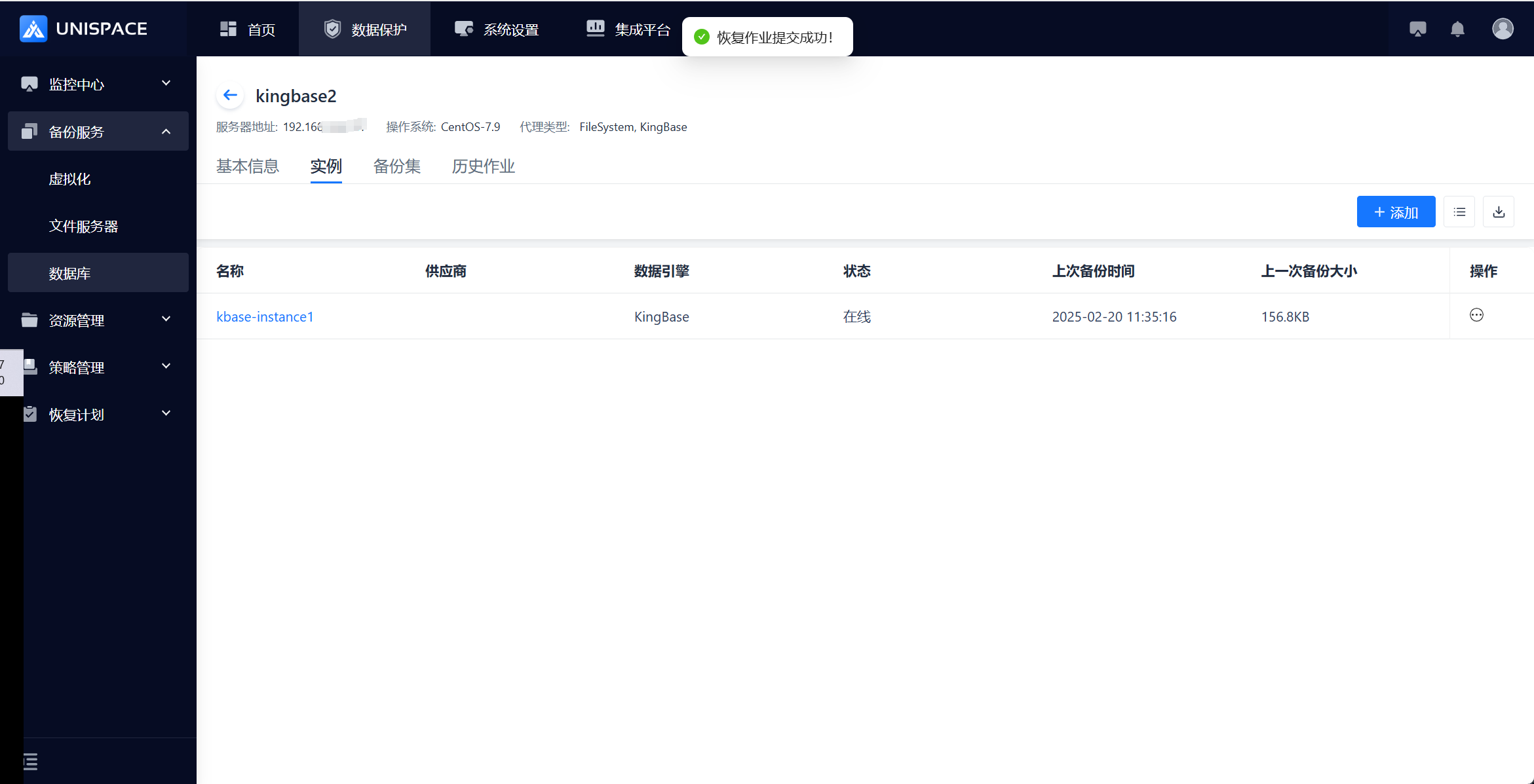
 Step 7: After completion, go to Monitoring Center - Jobs - Job History to see the recovery job status.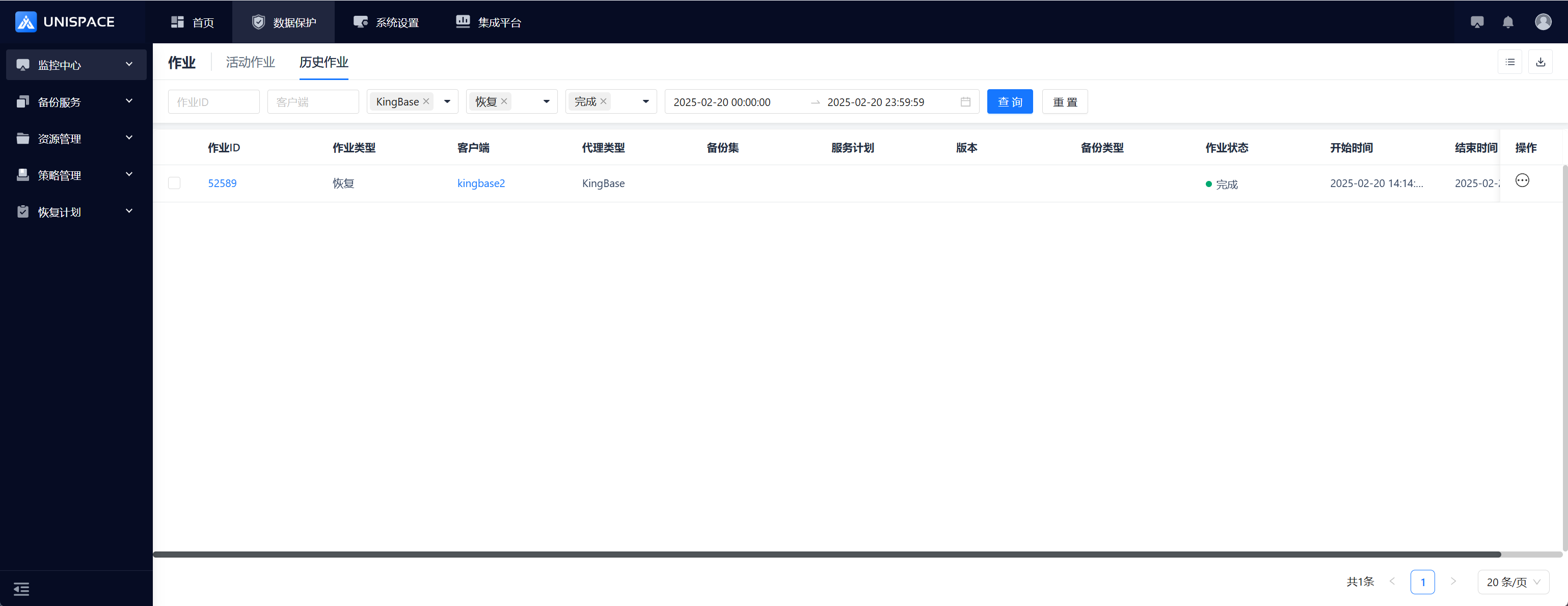
1.7 Kingbase Database Restore to Disk
Prerequisites
- A backup of the Kingbase database has been completed.
Steps
Step 1: Click on the system menu Backup Service - Database - Server Name to enter the instance list.Step 2: Select Instance, click the Operation column and select Restore, then choose Database Restore and click Next.Step 3: A restore window will pop up. Choose the restore point, which can be filtered by time range. Select the "Database" and "Backup Time", then click Next (cross-backup-set restore is not supported).Step 4: Set the restore options, choose Disk, fill in the necessary parameters, and click OK.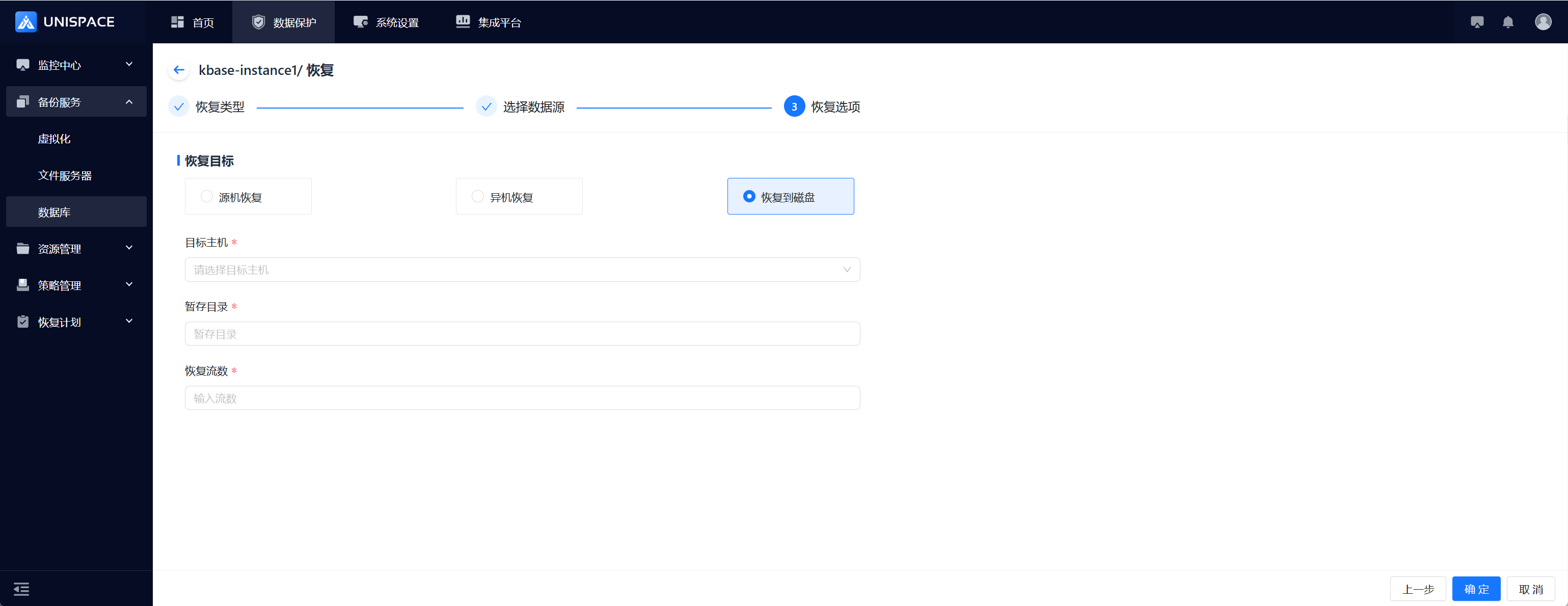 Step 5: Once the job starts successfully, go to Monitoring Center - Jobs - Active Jobs to view the job.Step 6: After the job completes, go to Monitoring Center - Jobs - History Jobs to view the job and its status.
1.8 Kingbase Instance (Log) Restore
Prerequisites
- Both the Kingbase instance and log backups have been completed.
Steps
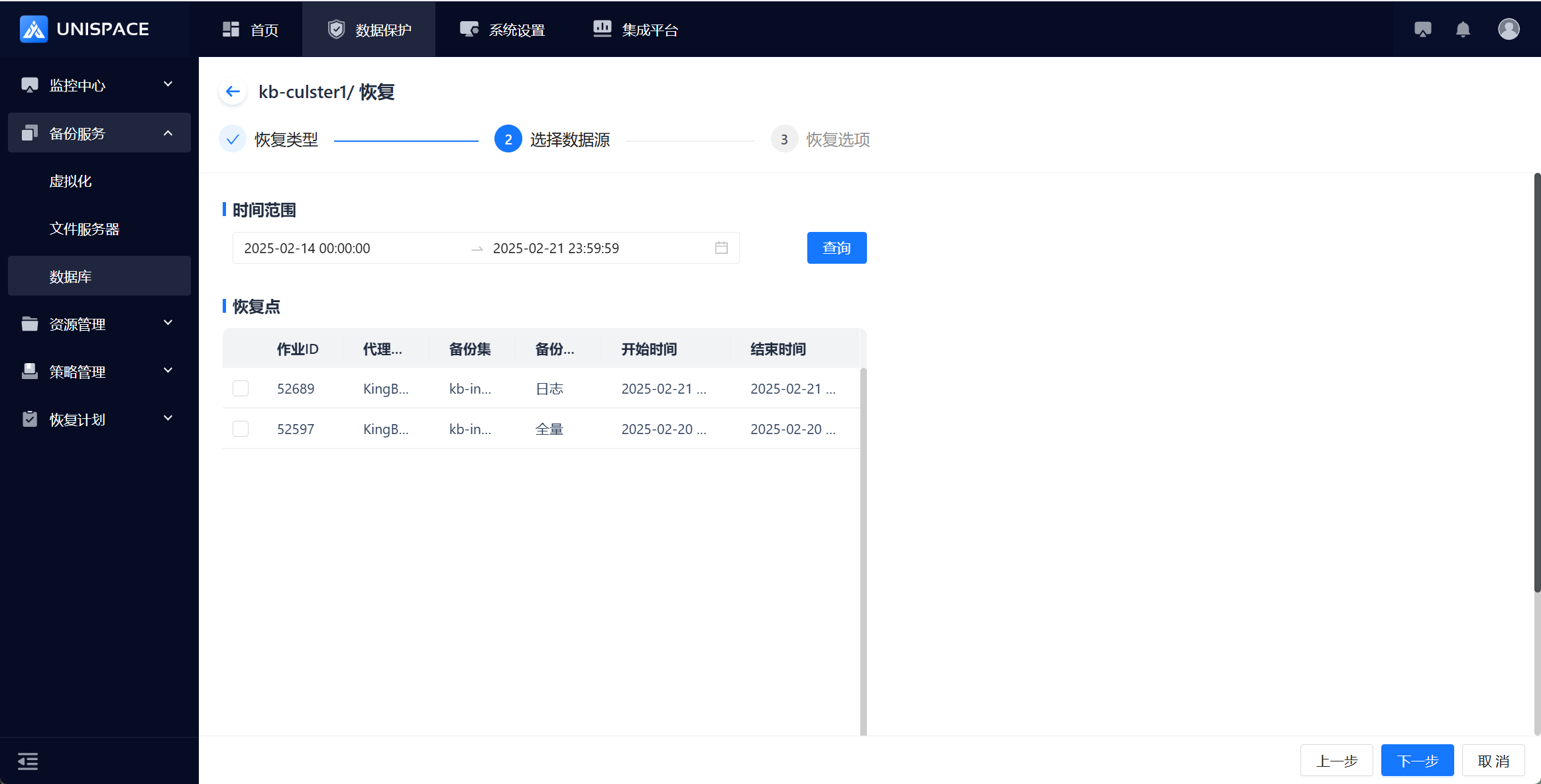
Step 1: Click on the system menu Backup Service - Database - Server Name to enter the instance list.Step 2: Select Instance, click the Operation column, choose Restore, then select Instance Restore and click Next.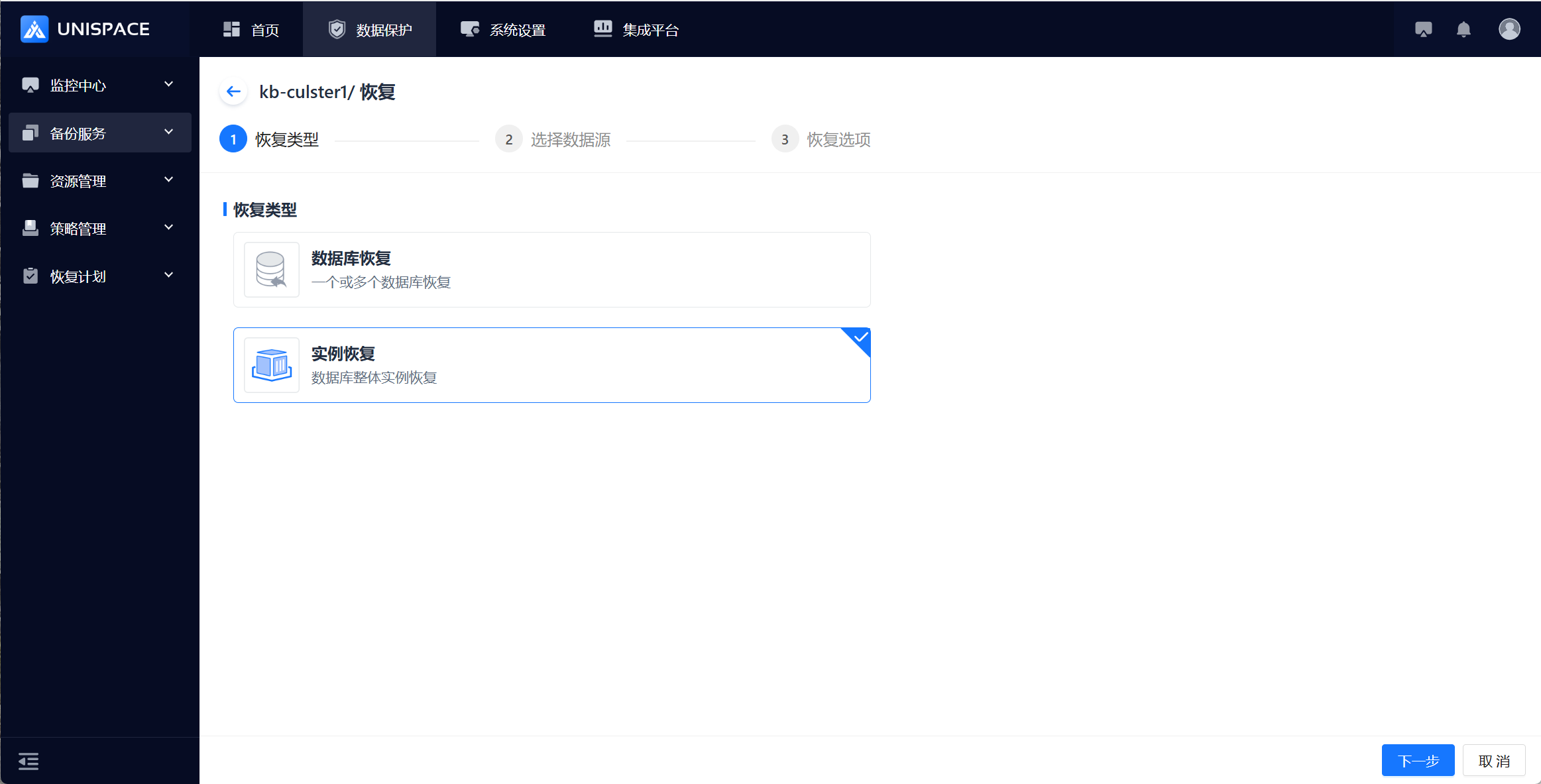 Step 3: A restore window will pop up. Choose the restore point, which can be filtered by time range. Select "Full" or "Log" and click Next.
 Step 4: Set the restore options, supporting Source Machine, Other Machine, and Restore to Disk. Fill in the necessary parameters and click OK.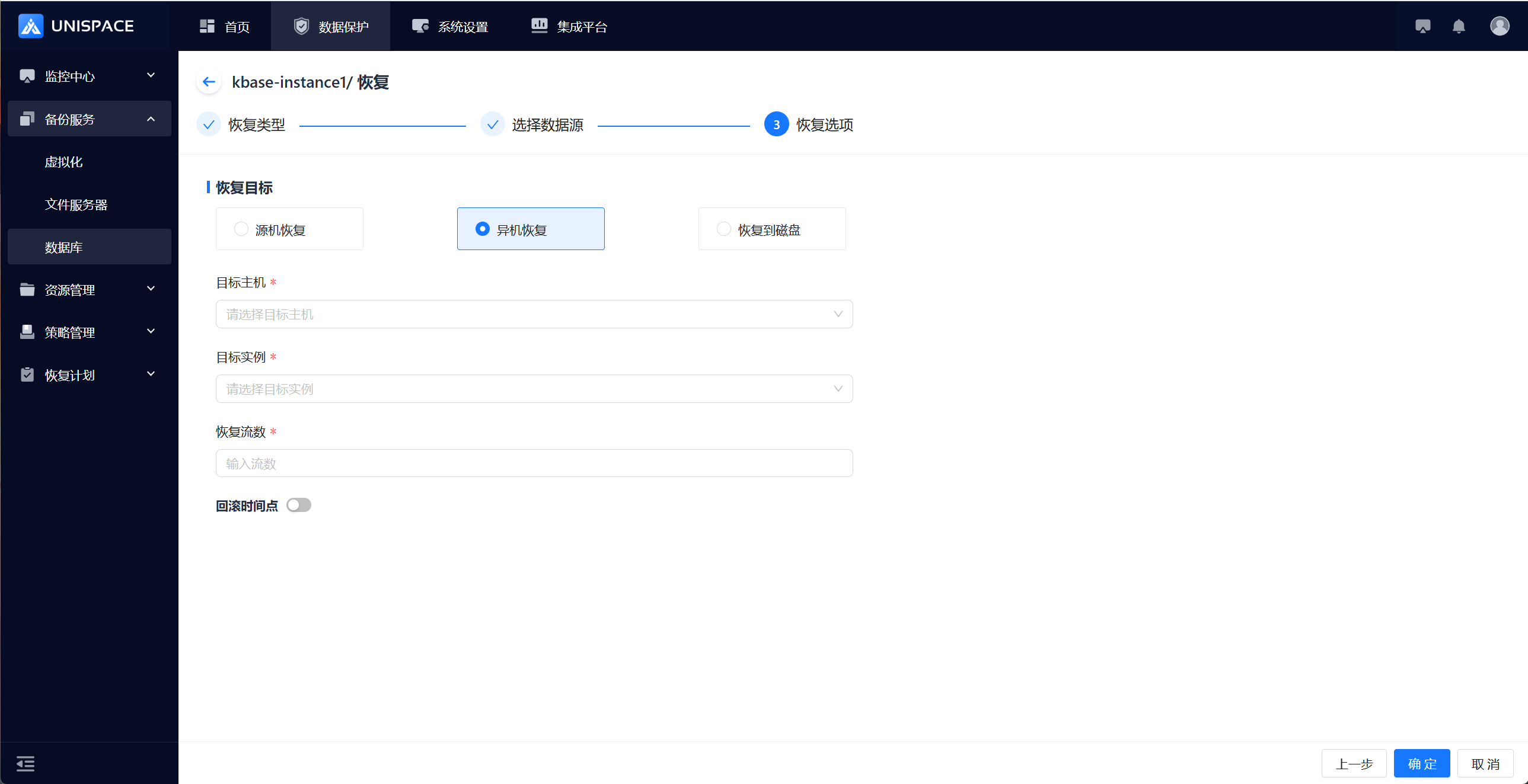
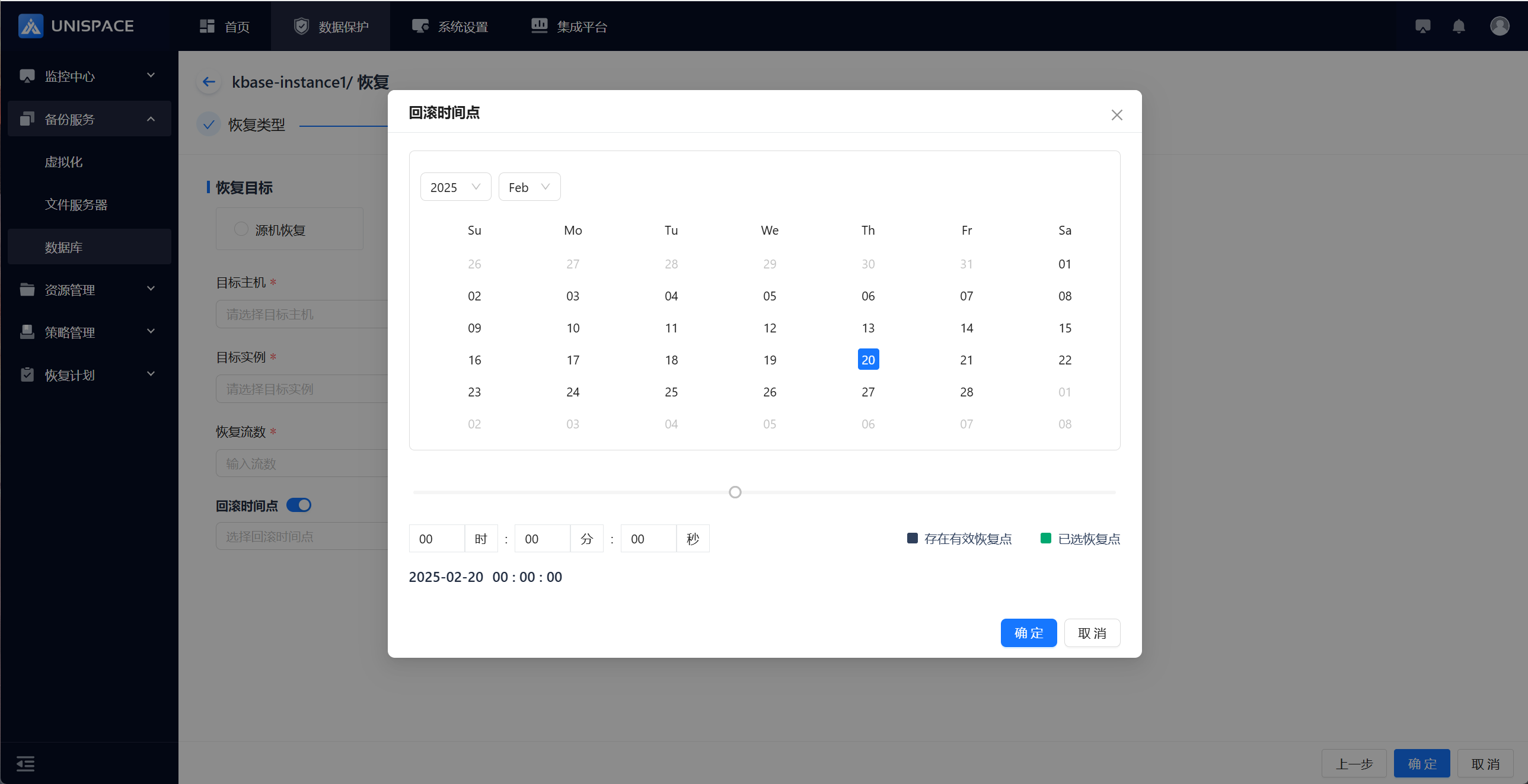 Step 5: Fill in the necessary parameters as outlined in the table below:
| Parameter Name | Description | Setting Principle |
|---|---|---|
| Restore Target | Default is other machine | Source Machine; Other Machine; Restore to Disk |
| Target Host | Default is other machine | Supports other machines, source machine (grayed out if local), or restore to disk (all client nodes) |
| Target Instance | Automatically linked with the target host | Select the successful Kingbase instance on the target host, greyed out |
| Restore Streams | Numeric type | Maximum value of 200, recommended value of 4 |
| Rollback Time | Default is off, restores to the selected restore point backup time if off | Enable and select a rollback point from the calendar or custom time |
Step 6: After the job starts successfully, go to Monitoring Center - Jobs - Active Jobs to view the job.Step 7: After the job completes, go to Monitoring Center - Jobs - History Jobs to view the job and its status.
2.1 Add Kingbase Virtual Cluster
Prerequisites
- The Kingbase service is already installed and accessible.
- A client with Kingbase service is registered to the management node.
Steps
Step 1: Click on the system menu Backup Service - Database - Virtual Cluster to enter the virtual cluster page.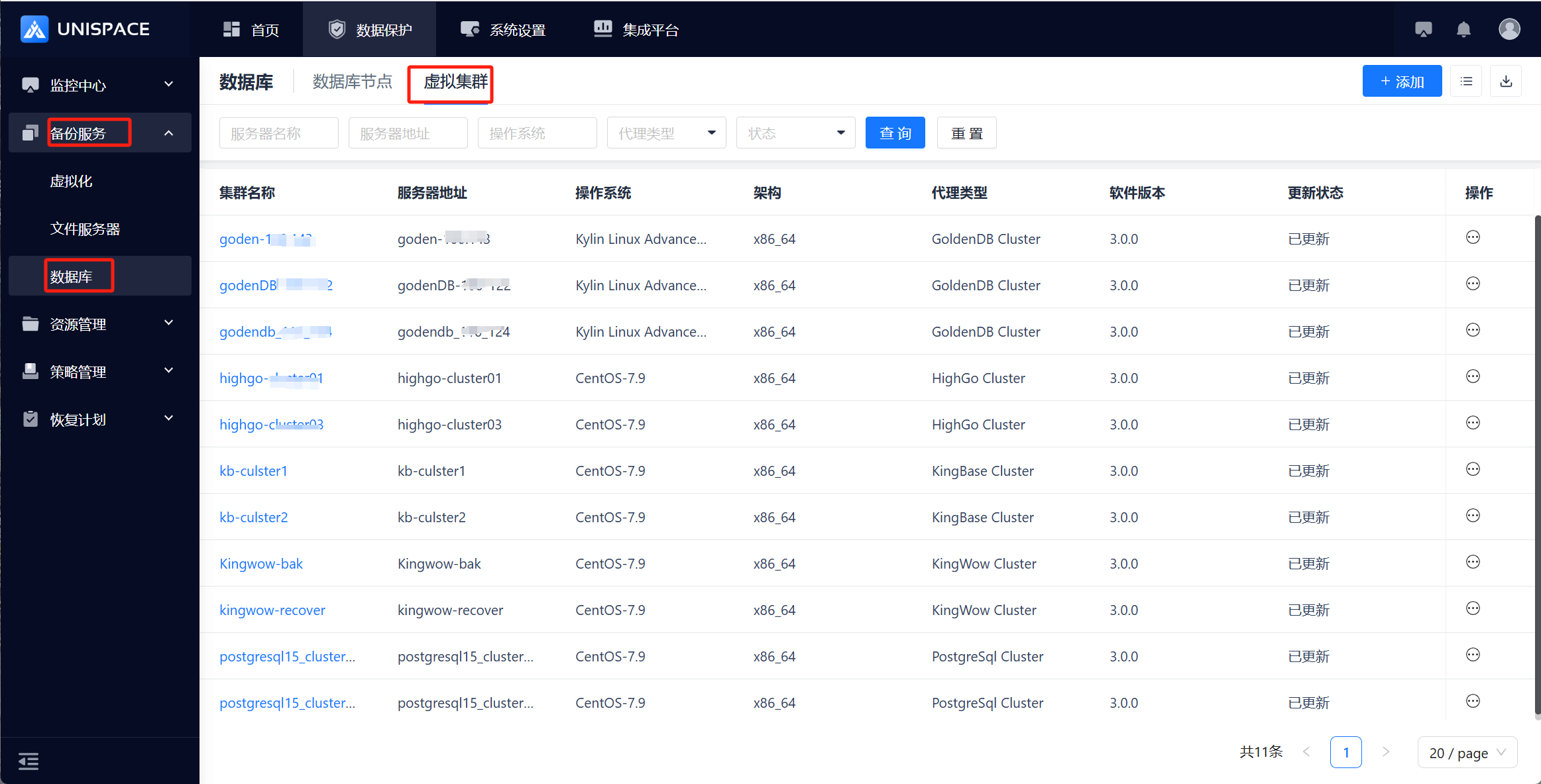 Step 2: Click the Add button at the top right corner and select KingBase from the pop-up window.
 Step 3: Add the virtual cluster and instance.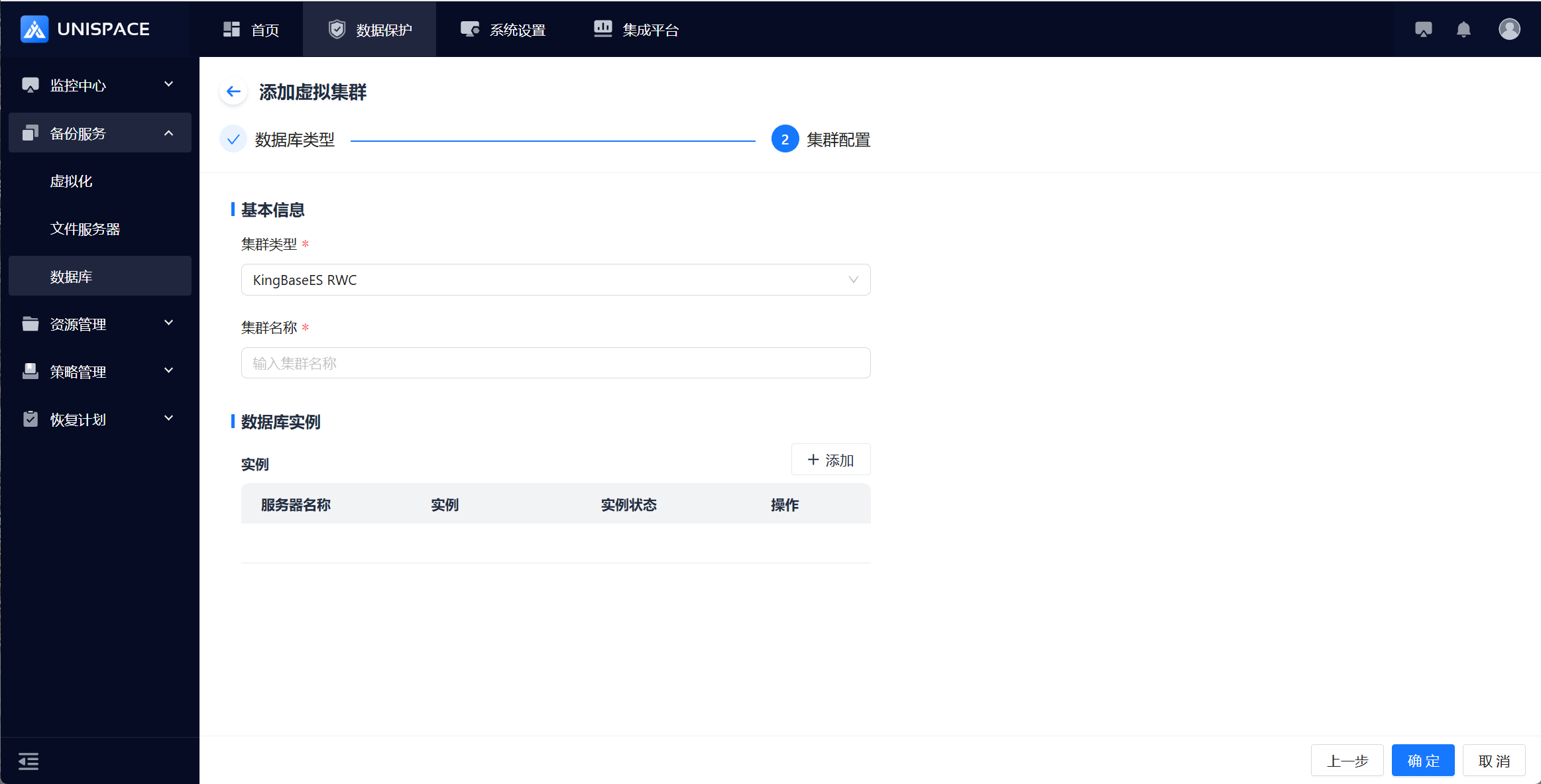
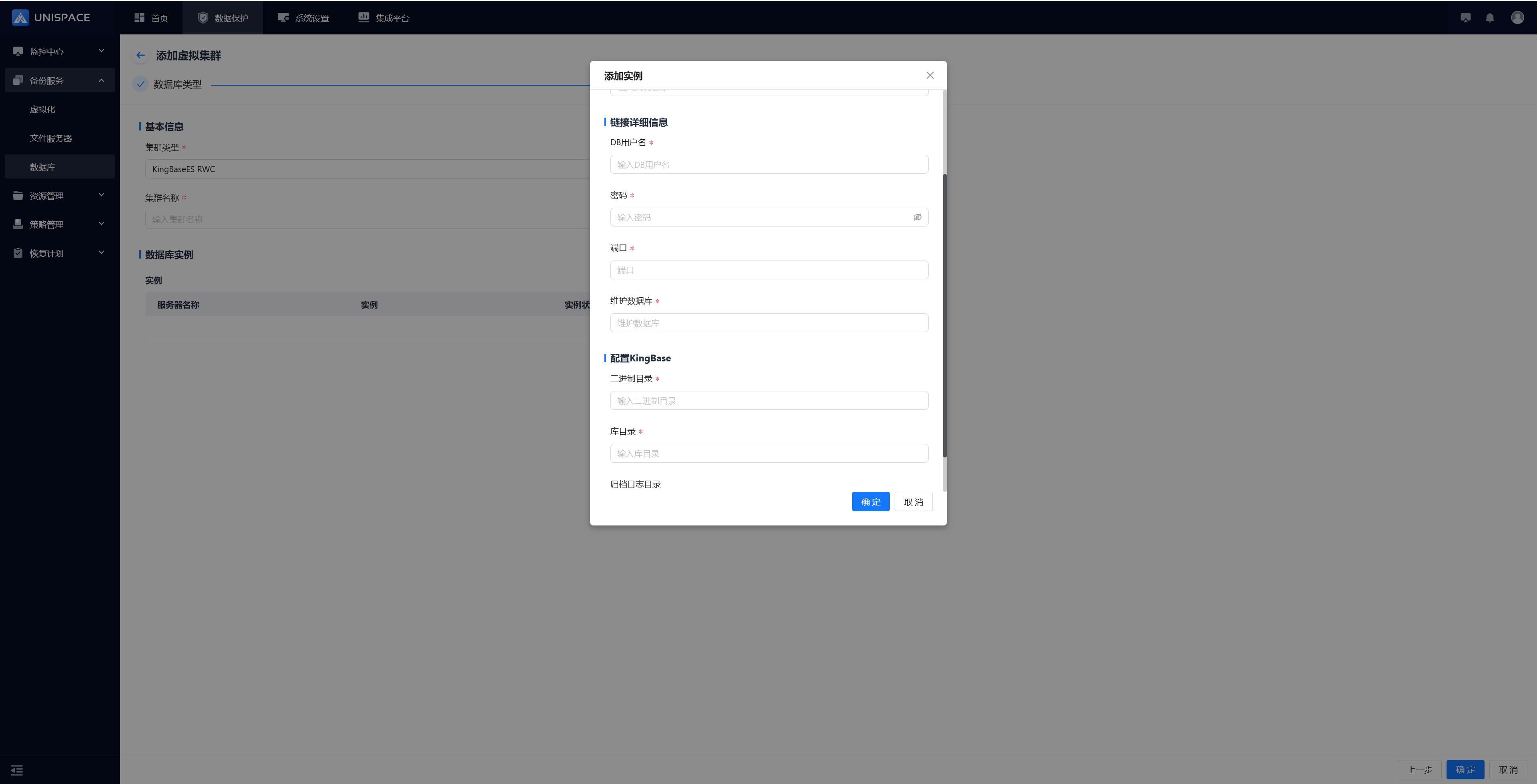 filling in the necessary parameters as shown below:
| Parameter Name | Parameter Description | Setting Principle |
|---|---|---|
| Cluster Type | Default: KingBaseES RWC | - |
| Cluster Name | Text input box, required, customizable | No restrictions on length or special characters |
| Instance Information Parameter | ||
| Server Name | Single selection dropdown, required | Select the server name where Kingbase is located |
| Instance Name | Text input box, required, customizable | No restrictions on length or special characters |
| DB Username | Username input box, required | Enter the Kingbase username |
| Password | Password input box, Password type | Enter the Kingbase password |
| Port | Input box, required | Port number, default: 54321 |
| Maintenance Database | Input box, required | Default value: kingbase |
| Binary Directory | Input box, required | Enter the correct Kingbase binary directory |
| Database Directory | Input box, required | Enter the correct Kingbase database directory |
| Archive Log Directory | Input box, path format | Customizable |
Step 4: Click OK after filling in the details. A success message will appear.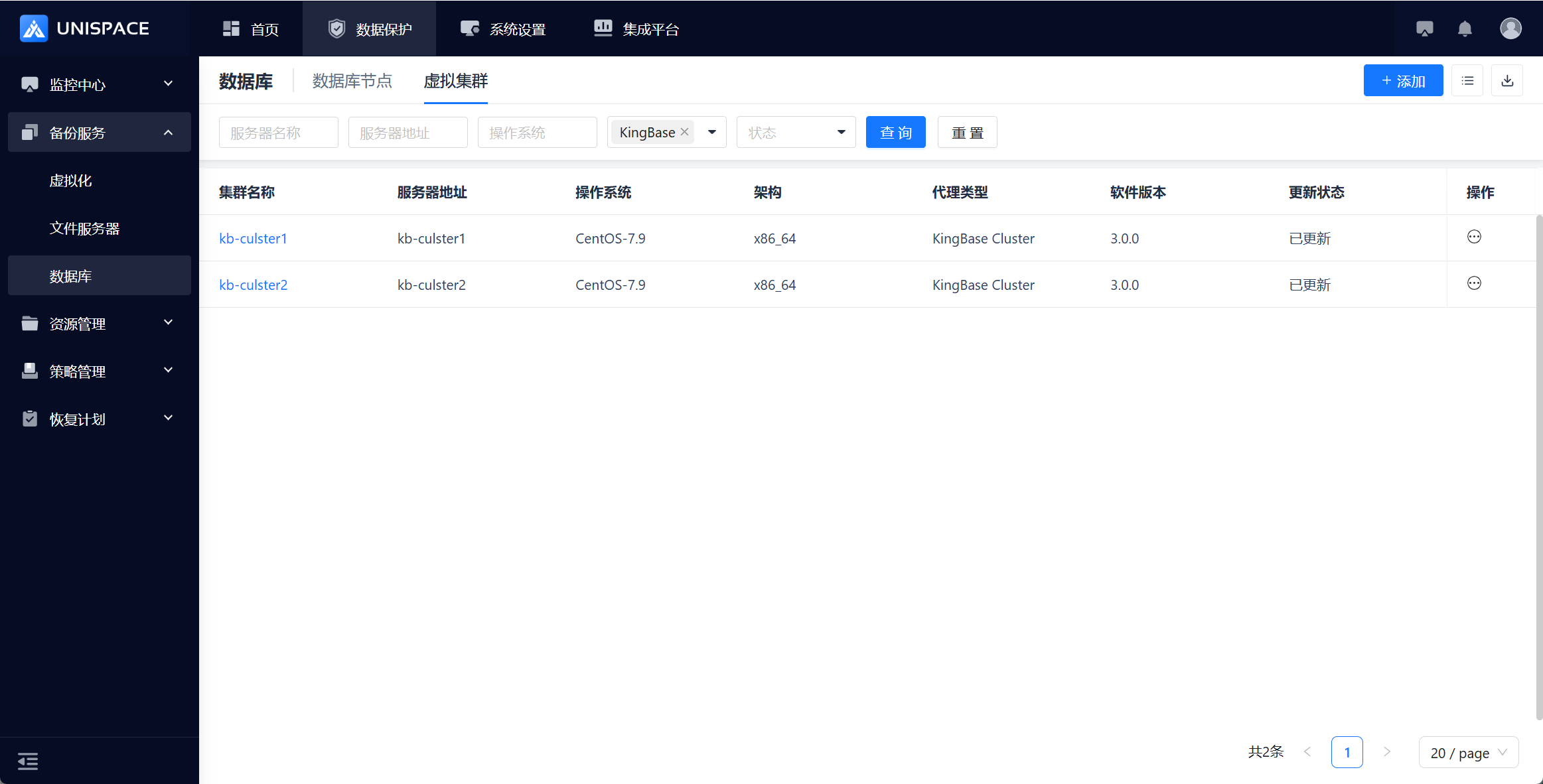 Step 5: The instance details will show cluster node information, where priority can be set (lower number indicates higher priority). Backups will be initiated based on priority.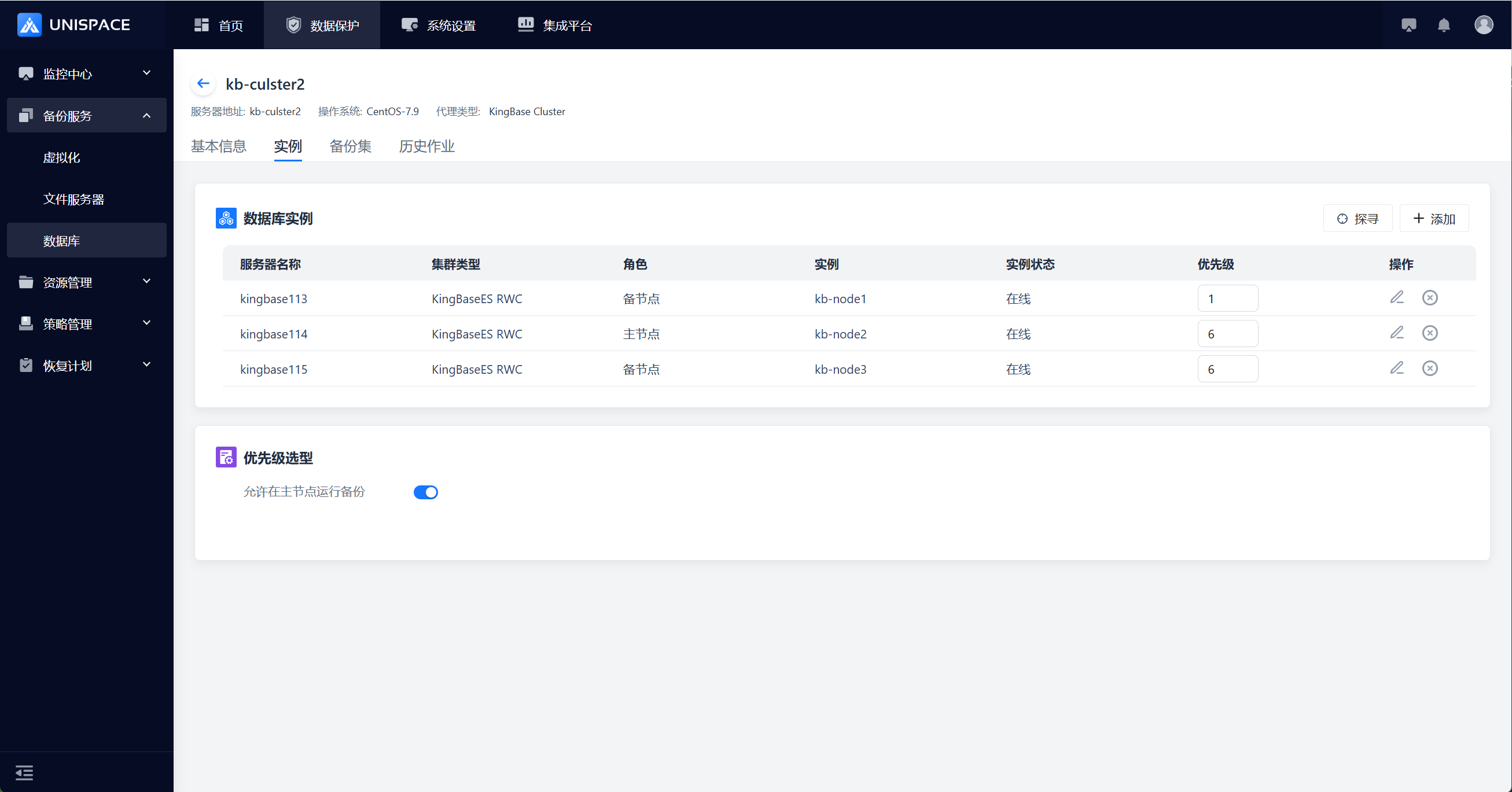
2.2 Create Kingbase Backup Object Collection (Refer to Section 1.2)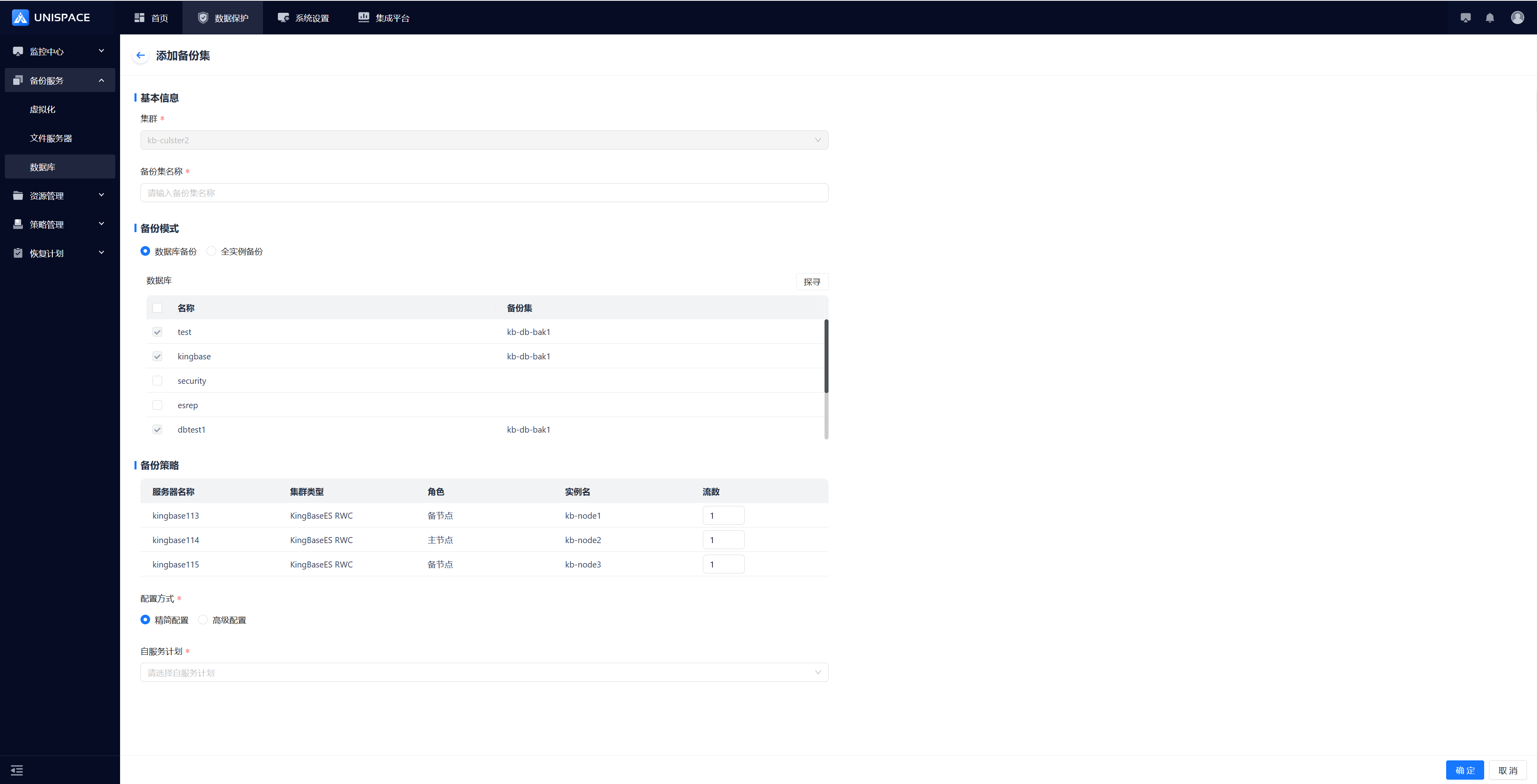
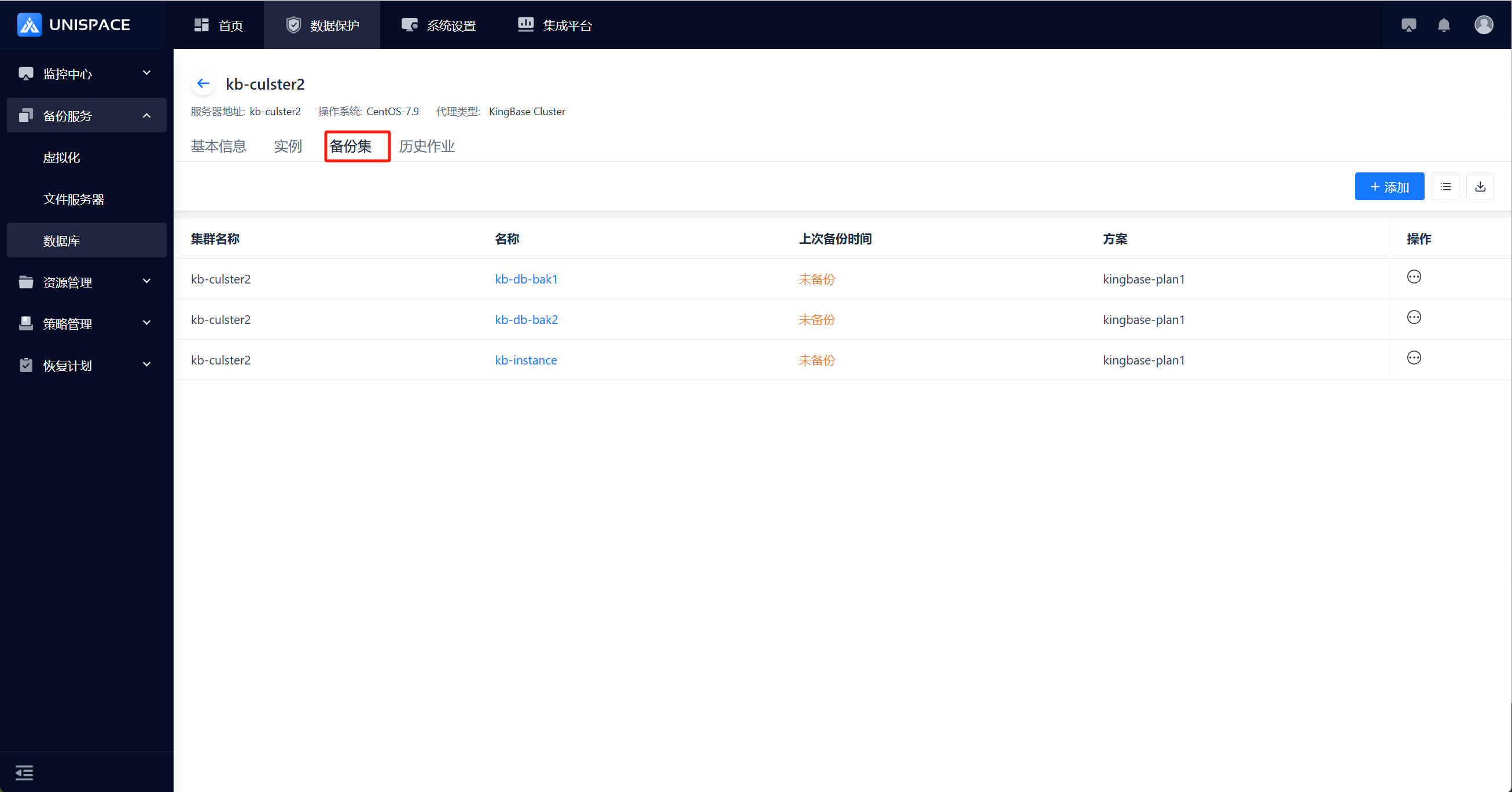
2.3 Kingbase Instance Backup (Cluster) (Refer to Sections 1.3-1.5)
2.4 Kingbase Restore (Cluster) (Refer to Sections 1.6-1.8)
Prerequisites
- A backup of the Kingbase database has been completed.
Steps
Step 1: Select Cluster, click the Operation column, choose Restore, and select Database Restore, then click Next.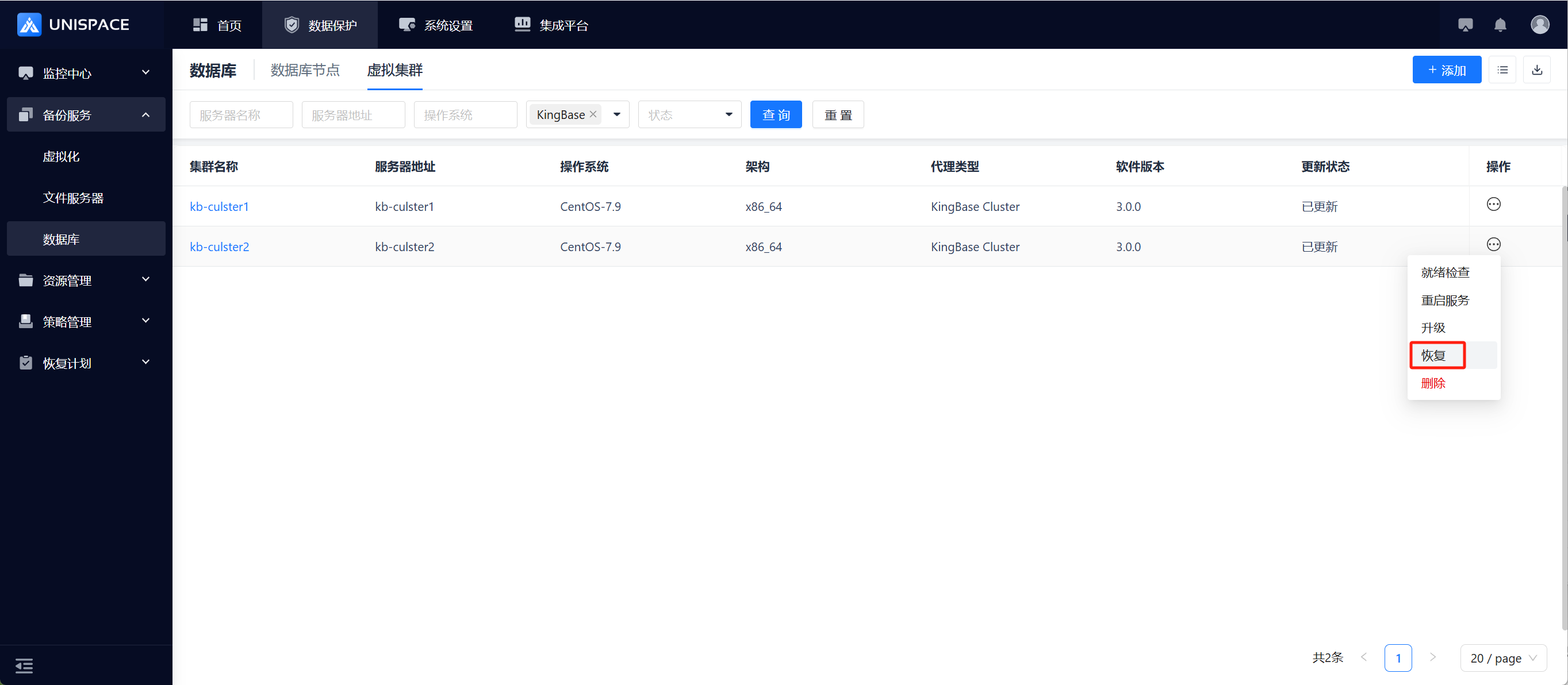
 Step 2: A restore window will pop up. Choose the restore point, which can be filtered by time range. Select the "Database" and "Backup Time", then click Next (cross-backup-set restore is not supported).
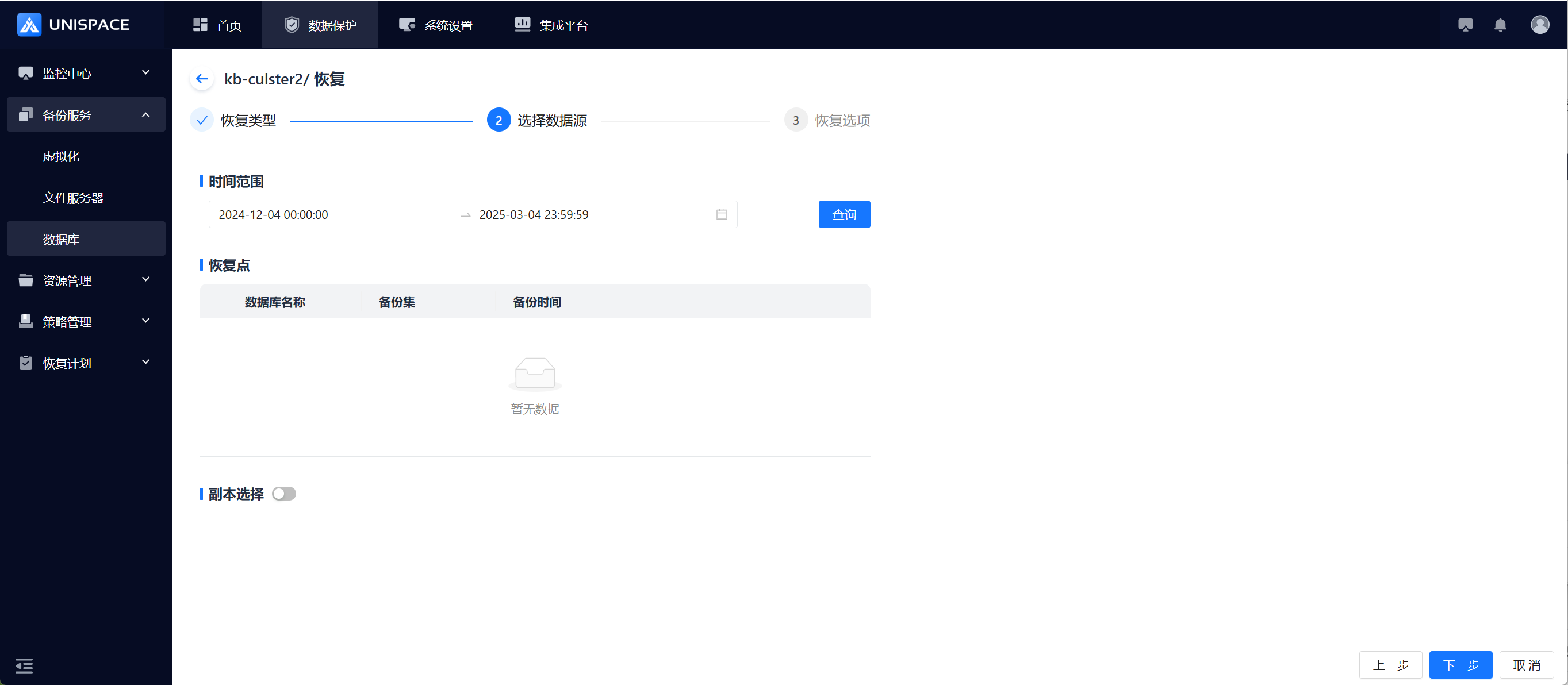 Step 3: Set the restore options and click OK.Step 4: Fill in the necessary parameters as shown below:
| Parameter Name | Description | Setting Principle |
|---|---|---|
| Restore Target | Default: Other Machine | Source Machine; Other Machine; Restore to Disk |
| Target Host | Default: Other Machine, drop-down selection | Other Machine: client node with Kingbase service, cluster node, or standalone machine; Source Machine: grayed out as local; Restore to Disk: all client nodes |
| Target Instance | Automatically linked with the target host | Select any node within the cluster to restore |
| Restore Streams | Numeric type | Maximum value of 200, recommended value of 4 |